
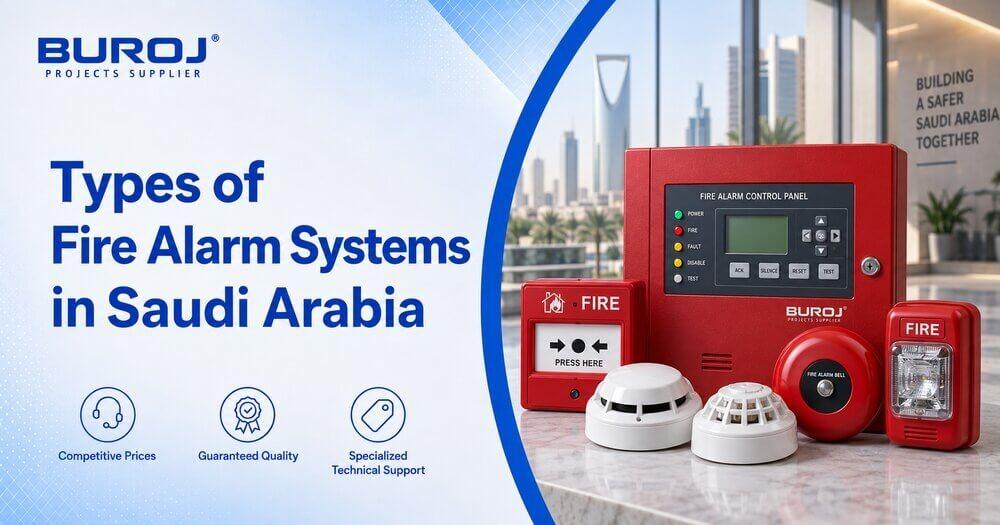
The main types of fire alarm systems differ in how they detect a fire and how they report its location. That difference decides your cabling design, panel capacity, and how fast a facility team reaches the right room. On Saudi projects, it also affects approval, since a system that performs well but lacks the required documentation will delay handover. This guide covers the five system types, how they compare, what a complete system includes, and the requirements that apply in the Kingdom.
What Are the Main Types of Fire Alarm Systems?
Systems are grouped by how devices talk to the control panel. The five types of fire alarm systems below cover almost every commercial and industrial installation.
1. Conventional Fire Alarm Systems
The building is split into zones, each wired on its own circuit to the panel.
- The panel shows the zone, not the exact device
- Lowest panel and device cost
- Responders check every device in the zone to find the activated one
- Cable cost rises fast, since every zone needs its own circuit
- Best for villas, small offices, retail units, and simple warehouses
2. Addressable Fire Alarm Systems
Every device carries a unique address on a loop.
- The panel names the exact device and its location text
- One loop takes 99 to 250 devices, depending on the protocol
- Far less cable than separate zone circuits
- A closed loop keeps working if the cable breaks at one point
- Best for hotels, schools, offices, hospitals, and multi-storey buildings
3. Intelligent or Analog Addressable Fire Alarm Systems
Devices send measured readings instead of a simple alarm signal, and the panel decides.
- Pre-alarm warning before the full alarm threshold
- Automatic compensation as detectors collect dust
- Dirty-detector alerts for maintenance planning
- Separate sensitivity for occupied and unoccupied hours
- Fewer false alarms, at the highest cost per device
- Best for hospitals, data centers, airports, and laboratories
4. Wireless Fire Alarm Systems
A radio link replaces the detection cabling.
- No cable runs to detectors
- Battery powered, typically rated three to five years
- Needs a radio survey, since concrete and metal cut signal strength
- Battery replacement becomes a scheduled task
- Best for heritage buildings, finished fit-outs, and temporary setups
5. Hybrid Fire Alarm Systems
Wired and wireless devices on one platform, or conventional zones connected to an addressable panel.
- A new wing runs as addressable loops while old zones stay in service
- Avoids replacing equipment that still works
- Useful when one area cannot be cabled, such as an atrium or a finished section
- Needs careful documentation, as two methods complicate commissioning
- Best for extensions and phased projects
Types of Fire Alarm Systems Comparison: Which Is Best for Your Project?
Here is the short comparison between the five types of fire alarm systems.
- Conventional: cheapest, shows the zone only, small buildings
- Addressable: mid cost, shows the exact device, most commercial buildings
- Intelligent addressable: highest cost, shows sensor readings, high-risk facilities
- Wireless: mid to high cost, no detection cabling, retrofits
- Hybrid: cost varies, mixes both methods, extensions and phased work
Three things decide it:
- Device count. Under 40 points, conventional usually costs less. Above that, addressable wins.
- Response time. If the team needs the exact device, conventional is out.
- Approval. Larger and higher-risk buildings in Saudi Arabia are normally specified as addressable.
Conventional vs Addressable Fire Alarm Systems
The two most common options differ in one thing: what the panel tells you.
Choose conventional when:
- The building is small and single-storey
- Four zones or fewer are enough
- The budget is tight
- The layout is simple, so searching a zone takes little time
Choose addressable when:
- The building has multiple floors or a large footprint
- Device count is above 40
- The facility team needs the exact device on the panel display
- Future expansion is likely
- The system must integrate with HVAC, lifts, access control, or a public address system
On cost: the addressable panel costs more, but it needs far less cable. Conventional needs a separate circuit per zone. Addressable puts up to 250 devices on one loop. On any medium or large building, the cable saving usually covers the panel difference.
Read more: Addressable Fire Alarm System in Saudi Arabia: Complete Design & Installation Guide
Fire Alarm System Components: What Does a Complete System Include?
The fire alarm system components below make up a complete installation, whichever system type is used.
- Control panel (FACP): monitors all devices and triggers the alarm outputs
- Detectors: smoke, heat, flame, or multi-sensor units
- Manual call points: break-glass units for manual activation
- Sounders and strobes: bells, horns, and visual alarm devices
- Voice evacuation: speakers and amplifiers, required on larger occupancies
- Power supply and batteries: standby power to keep the system running during a mains failure
- Fire-rated cabling: circuits that keep working under fire conditions
- Interface modules: relay and monitor modules linking the panel to other building systems
- Repeater panel: a second display at reception or the security room
- Integration outputs: AHU shutdown, lift homing, door release, and damper control
Read more: Fire Alarm Systems Installation in Saudi Arabia: Complete Guide 2026
Detection Technologies Used with Different Types of Fire Alarm Systems
Detector choice depends on the space, not the panel. All types of fire alarm systems can use most of the technologies below.
- Optical (photoelectric) smoke: best for slow, smouldering fires. Standard for offices, corridors, and bedrooms.
- Heat detectors: fixed temperature or rate-of-rise. Used where smoke detectors would false alarm, such as kitchens, car parks, and dusty areas.
- Multi-sensor: combines smoke and heat sensing in one unit. Fewer false alarms.
- Beam detectors: cover long distances across high spaces. Used in atriums and warehouses.
- Aspirating detection: draws air samples through pipework for very early warning. Used in data centers and high-value areas.
- Flame detectors: UV or IR sensing for fast-flaming fuel fires. Used in fuel stores and industrial plants.
- Duct detectors: installed in HVAC ducts to stop smoke spreading through the air system.
- Linear heat cable: detects heat anywhere along its length. Used in cable trays and tunnels.

Fire Alarm System Requirements in Saudi Arabia
Not all types of fire alarm systems are accepted on every project in Saudi Arabia. The system has to meet the code, pass Civil Defense approval, and arrive with the right documents. Below are the five requirements that matter most.
Saudi Fire Protection Code SBC 801
SBC 801 is the fire protection part of the Saudi Building Code. It sets what a building needs based on its occupancy type, height, and risk level.
- It decides whether detection is required, and in which areas
- It sets the level of coverage for each occupancy class
- It references international standards for the technical detail
- Occupancy class is the starting point, so it should be confirmed before any system is selected
Saudi Civil Defense and Salamah Requirements
Civil Defense is the approval authority. No building gets its safety licence without their acceptance.
- Design drawings are submitted for review before installation starts
- The Salamah platform is used for safety licence applications and follow-up
- An inspection is carried out on site before the licence is issued
- Equipment is expected to carry recognised approvals such as UL or FM
- Larger and higher-risk buildings are normally specified as addressable
NFPA 72 and Referenced Project Standards
Saudi specifications commonly reference NFPA 72 for the technical detail of the installation.
- Detector spacing and mounting positions
- Sounder levels and audibility across occupied areas
- Circuit classes and how faults are handled
- Inspection and testing frequencies after handover
Approved Drawings, Submittals and Datasheets
Approval is a paper process as much as a technical one.
- Shop drawings showing device locations, loops, and cable routes
- Material submittals for panel, detectors, sounders, and cable
- Manufacturer datasheets and listing certificates for every item
- A cause-and-effect matrix showing what each activation triggers
- Consultant approval before ordering, not after
Testing, Commissioning and Handover Documentation
The system is only complete once it has been tested and the records handed over.
- Every device tested and logged individually
- Cause-and-effect verified against the approved matrix
- Battery standby calculations checked
- Integration with HVAC, lifts, and doors confirmed
- As-built drawings, O&M manuals, and training records issued
Read more: Conventional Fire Alarm Systems in Saudi Arabia
How to Choose Among the Types of Fire Alarm Systems in Saudi Arabia
Work through these six points in order.
- Confirm the occupancy classification. This decides what the code requires before anything else is chosen.
- Count the devices. Under 40 points, conventional is usually enough. Above that, go addressable.
- Read the specification. If it names a system type or a standard, that decision is already made.
- List the integrations. HVAC, lifts, doors, and public address all need interface modules planned from the start.
- Allow for expansion. Leave spare loop capacity so a future phase does not need a new panel.
- Check local support. Confirm spare parts and technical support are available inside the Kingdom.
Common Mistakes When Selecting a Fire Alarm System
These mistakes cost the most on site.
- Choosing conventional for a building that will grow
- Ordering equipment before the submittal is approved
- Mixing panel and devices from different manufacturers
- Using smoke detectors in kitchens, car parks, and dusty areas
- Comparing unit prices without counting cable and labour
- Leaving integration until the commissioning stage
- Handing over without as-built drawings or test records
- Filling every loop to capacity, leaving no room to expand
How El Buroj Supports Fire Alarm Projects in Saudi Arabia
Design and Engineering Support
El Buroj picks the right system type for the building and prepares the loop design and drawings.
Fire Alarm System and Component Supply
Panels, detectors, sounders, and interface modules, all supplied with their approval certificates.
Installation and System Integration
The team installs the devices, sets up the panel, and links it to HVAC, lifts, and doors.
Testing & Commissioning
Every device is tested and logged, and the team attends the Civil Defense inspection.
Maintenance and Technical Support
Scheduled visits, fast fault response, and spare parts held inside the Kingdom.
Get the best fire alarm systems for your project at the best price from El Buroj. Send your drawings or bill of quantities and receive project pricing. Call 920031298 or contact us on WhatsApp.
Read more: Top Fire Alarm System Suppliers in Saudi Arabia 2026
FAQs About Types of Fire Alarm Systems
What are the five types of fire alarm systems?
Conventional, addressable, intelligent or analog addressable, wireless, and hybrid.
What are the four main types of alarm systems?
Some classifications drop hybrid and list conventional, addressable, intelligent, and wireless.
What are L1, L2, and L3 fire alarm systems?
British Standard BS 5839 life protection categories: L1 covers all areas, L2 adds defined high-risk rooms, and L3 covers escape routes and the rooms opening onto them.
What is a type 6 fire alarm system?
It is not a category in NFPA 72 or SBC 801, so check what the project specification actually means by it.
What is the simplest type of fire alarm?
A conventional system, which reports the activated zone rather than the individual device.
Which type of fire alarm is best?
There is no single best option: addressable suits most commercial buildings, and intelligent addressable suits hospitals and other high-risk facilities.