
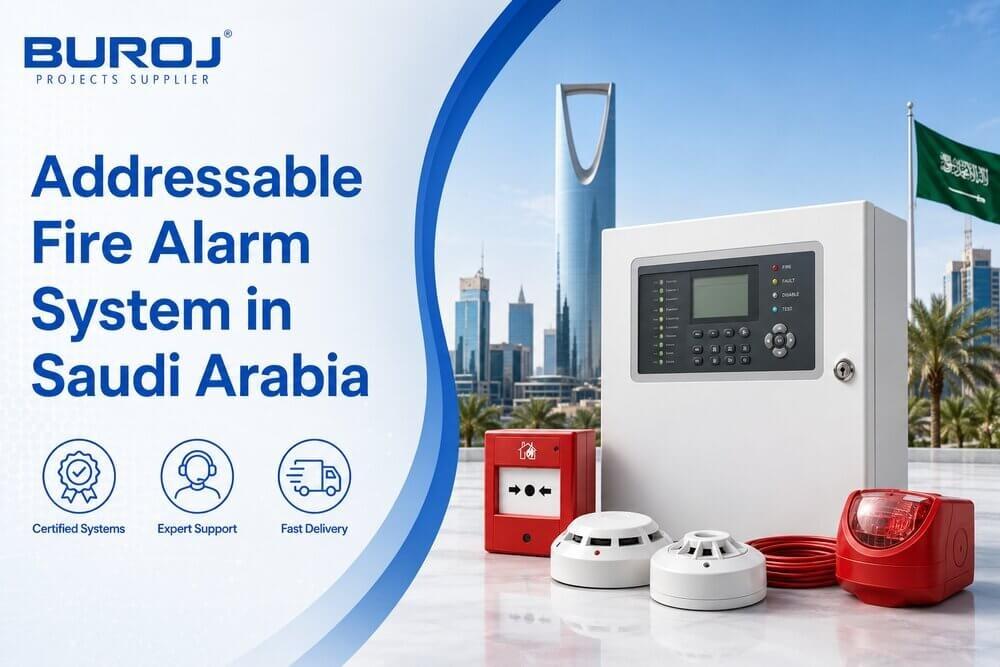
A fire alarm activates on the 12th floor of a 30-storey Riyadh tower. The control room receives a zone alert, but which floor? Which room? Precious minutes are lost while teams search. An addressable fire alarm system eliminates that ambiguity. Every device has a unique address. When it activates, the panel displays its exact location, instantly enabling faster evacuation, precise emergency response, and full Saudi Civil Defense compliance. For consultants, project managers, and safety professionals, the addressable fire alarm systems at El Buroj deliver the accuracy large projects demand.
What Is an Addressable Fire Alarm System?
Every device; smoke detector, heat detector, call point, module carries a unique electronic address. When one activates, the panel shows exactly which device, in which room, on which floor.
Compare this to a conventional system: a zone alarm tells you "fire somewhere in the east wing." An addressable fire alarm system tells you "smoke at Detector 047, third-floor server room, east wing."
The operational difference is significant:
- Emergency responders go directly to the right location
- False alarms are investigated without triggering full evacuations
- Maintenance teams identify faulty devices by address, not by walking every corridor
Ready to specify your addressable fire alarm system? Request a project consultation from El Buroj today.
Contact us via WhatsApp | Call us
Main Components of an Addressable Fire Alarm System
All components must be compatible, certified, and work as a coordinated platform. A single uncertified device can compromise the entire loop.
Fire Alarm Control Panel (FACP)
The operational brain of the system. The FACP polls every device continuously, processes signals, and displays real-time status.
When an alarm occurs, the panel shows the device address, location label, and event timestamp, not just a zone. Fire wardens and Civil Defense teams reach the right location immediately.
Addressable Smoke Detectors
The primary detection device for most addressable fire alarm systems. Each detector communicates individually with the panel, activation displays the exact device location instantly.
Standard for: offices, hotels, commercial buildings, and educational facilities.
Heat Detectors
Used where smoke detectors would generate false alarms: generator rooms, kitchens, car parks, and industrial areas.
They complement smoke detectors in a well-zoned addressable system, eliminating detection gaps in challenging environments.
Manual Call Points
Positioned at exit routes, stairwells, and escape corridors per NFPA 72 and Saudi Civil Defense requirements.
Each call point carries a unique address; when activated, the panel identifies the exact location to support accurate emergency coordination.
Input and Output Modules
Modules extend the system beyond detection into automated emergency response:
- Input modules: Monitor suppression systems, flow switches, and pressure sensors
- Output modules: Trigger HVAC damper release, elevator recall, access control release, and suppression pre-action sequences
This integration layer is mandatory for hospitals, data centres, and high-rise commercial buildings.
Sounders and Strobes
Addressable notification devices can be activated individually or in groups, enabling staged evacuation, floor-by-floor, before escalating to a full building alarm.
Strobes provide visual notification for hearing-impaired occupants, supporting compliance with Saudi accessibility requirements.
Addressable Loop Wiring
All devices connect on a single continuous loop circuit from the panel. Key advantages over conventional wiring:
- Fewer cable runs: multiple devices share one circuit
- Supervised in both directions: a cable cut does not take the loop offline
- The panel isolates the fault and maintains communication with all other devices
This fault tolerance is critical for large buildings where a zone going offline is operationally unacceptable.
Fire Alarm Addressable System Wiring Diagram
A fire alarm addressable system wiring diagram shows how all components connect on a single supervised loop from the FACP:
- Loop leaves the panel and passes through each device sequentially
- Each device taps onto the loop at its installation point
- Loop returns to the panel, completing the circuit
- Output modules on the loop drive HVAC dampers, elevators, and access control
- Notification devices connect on the same loop or a separate supervised circuit
A compliant fire alarm addressable system design must be prepared by a qualified engineer per NFPA 72 and Saudi Civil Defense standards. El Buroj provides full design support as part of every project consultation.
Request fire alarm system design support. Our team produces compliant drawings and device schedules for your project.
Contact us via WhatsApp | Call us
Addressable vs Conventional Fire Alarm System
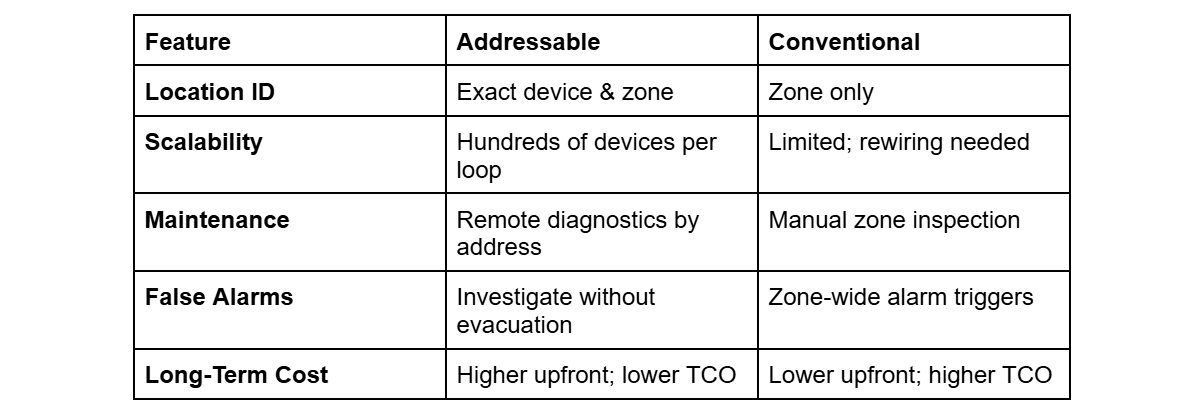
Both system types have a role in fire protection, but the choice between them significantly affects long-term performance, maintenance efficiency, and compliance capability. The following table provides an objective comparison across the criteria that matter most to project teams and safety managers:
- Location Identification: An addressable fire alarm system pinpoints the exact device and zone where the alarm originates, while a conventional system identifies only the affected zone.
- Scalability: Addressable systems can support hundreds of devices on a single loop, making future expansion easier, whereas conventional systems require additional wiring when new devices are added.
- Maintenance: Addressable systems provide remote diagnostics and identify the exact device needing maintenance, while conventional systems require manual inspection of the entire zone.
- False Alarms: With an addressable system, maintenance teams can investigate the specific device before initiating a full evacuation, while conventional systems typically trigger an alarm for the entire zone.
- Long-Term Cost: Although addressable systems have a higher initial investment, they offer a lower total cost of ownership (TCO) over time through easier maintenance and reduced wiring. Conventional systems have a lower upfront cost but often result in higher long-term maintenance and expansion costs.
For medium and large Saudi projects; hospitals, hotels, towers, factories, an addressable fire alarm system is the correct specification. Conventional systems remain viable only for small, low-complexity buildings with minimal compliance obligations.
Where Are Addressable Fire Alarm Systems Used?
The operational advantages of an addressable fire alarm system are most clearly realised in environments where large numbers of people are present, where rapid and precise emergency response is critical, or where business continuity depends on minimising unnecessary evacuations.
- Hospitals: Exact device location enables ward-level evacuation without disrupting the entire facility
- Hotels: Investigate isolated incidents without triggering full building evacuation
- Universities: Complex multi-building campuses require coordinated addressable detection
- Commercial towers: High-rise floor-by-floor evacuation protocols depend on precise alarm location
- Factories and warehouses: Mixed risk zones; production, storage, offices need differentiated detection
- Residential compounds: Scalable addressable platforms grow as development phases are added
Addressable Fire Alarm System Design Requirements in Saudi Arabia
Saudi Arabia's fire protection framework requires compliance with a combination of Saudi Civil Defense (SCD) regulations, NFPA 72 (National Fire Alarm and Signaling Code), and NFPA 101 (Life Safety Code). For any building exceeding a certain occupancy category, floor area, or building height, an addressable fire alarm system is either mandated or strongly recommended by the applicable standard.
Key design requirements from project inception:
- Risk assessment and occupancy classification: The design basis begins with a formal risk assessment that classifies the building's occupancy type and fire risk level. This determines the required detection coverage, alarm notification strategy, and integration obligations.
- Detector placement and spacing: NFPA 72 and SCD requirements specify maximum detector spacing, ceiling height correction factors, and special installation requirements for high airflow environments, sloped ceilings, and obstructed spaces.
- Alarm zoning: The system must be zoned to correspond to building evacuation sections, typically floor-by-floor for multi-storey buildings, with alarm notification designed to support staged or simultaneous evacuation as required by the life safety analysis.
- System integration: Saudi Civil Defense projects increasingly require the fire alarm system to interface with fire suppression, HVAC smoke control, emergency lighting, elevator recall, and access control. The low-current and light-current systems category at El Buroj covers the integration components required for these multi-system connections.
- Battery backup and power resilience: All systems must include supervised battery backup capable of maintaining the system in standby for a minimum period as specified by NFPA 72, typically 24 hours standby followed by 5 minutes alarm.
- Testing and commissioning: Every device on the system must be individually tested and commissioned in the presence of the responsible engineer, with a commissioning certificate and device test record submitted to the Civil Defense authority for building approval.
Engaging a qualified fire protection consultant and an experienced supplier at the design stage, not after tenders are awarded, is the single most effective way to avoid costly specification changes and delays during Civil Defense approval.
Addressable Fire Alarm System Cost in Saudi Arabia
No responsible supplier provides a fixed price for an addressable fire alarm system without reviewing the project. The variables that drive cost are significant:
- Building size and floor count: Total device count and loop configuration scale directly with building area and number of floors.
- Number of detection devices: Each addressable detector, call point, and module adds to the hardware cost. Device density is determined by room layout, ceiling type, and occupancy classification.
- Loop count: Larger buildings require multiple loops from the FACP. Each additional loop card increases panel cost.
- Integration requirements: HVAC interface, elevator recall, suppression system connections, and BMS integration each add hardware and engineering cost.
- Brand and certification: Systems specified to EN 54 or UL certification standards carry a premium over uncertified products. For Saudi Civil Defense approval, certification documentation is mandatory.
- Testing and commissioning: Full device-by-device commissioning and Civil Defense submission documentation adds to project cost but is non-negotiable for building handover.
The most important cost framework for decision-makers is Total Cost of Ownership (TCO). A higher-specification addressable system from a certified brand typically costs more at installation but delivers lower operational costs over its service life: fewer false alarms, faster fault identification, reduced inspection labour, and longer hardware longevity.
Systems specified on purchase price alone routinely generate far higher TCO through premature failure, non-compliance remediation, and operational disruption.
Why Choose El Buroj for Addressable Fire Alarm Systems?
El Buroj is a trusted fire protection solutions partner serving MEP consultants, fire protection engineers, safety managers, and contractors across Saudi Arabia. Our addressable fire alarm system service covers every project phase:
- Project Consultation: We review your building type, occupancy class, and Civil Defense requirements before specifying a single product.
- System Design Support: Our engineering team produces compliant detection layouts, device schedules, and loop configurations aligned with NFPA 72 and Saudi Civil Defense standards.
- Product Supply: A full range of certified addressable panels, detectors, call points, modules, sounders, and strobes; all with SASO-compliant documentation.
- Installation and Commissioning: In-house technical teams carry out device installation, loop commissioning, and individual device testing with full commissioning documentation for Civil Defense submission.
- Integration with Low-Current Systems: We design and supply the full integration layer connecting fire alarm to HVAC, elevators, suppression, access control, and BMS as a coordinated life-safety platform.
- Maintenance and After-Sales Support: Preventive maintenance programmes, rapid-response fault attendance, and spare parts availability to protect system compliance throughout the building's operational life.
- Bulk Supply for Contractors: Large-volume orders for government and commercial tenders fulfilled with guaranteed lead times and competitive pricing.
Ready to specify your addressable fire alarm system? Request a project consultation from El Buroj today.
Contact us via WhatsApp | Call us
FAQs About Addressable Fire Alarm Systems
What is an addressable fire alarm system?
A fire detection platform where every device has a unique electronic address. The control panel identifies the exact location of any activated device, enabling faster response and precise incident management.
How does an addressable fire alarm system work?
The control panel continuously polls all devices on the loop. When a device activates, it returns its unique address. The panel displays the device, location, and alarm type, and triggers the appropriate notification and integrated system responses.
What is the difference between addressable and conventional fire alarm systems?
Conventional systems identify only the zone. An addressable fire alarm system identifies the exact device, enabling precise evacuation, remote diagnostics, loop fault tolerance, and far greater scalability.
Where are addressable fire alarm systems used?
Hospitals, hotels, commercial towers, universities, factories, warehouses, and government buildings. Any facility requiring precise fire location, staged evacuation, or multi-system integration.
How much does an addressable fire alarm system cost in Saudi Arabia?
Cost varies by building size, device count, loop configuration, integration scope, and brand. Contact El Buroj with your project details for an accurate quotation including supply, installation, and Civil Defense documentation.
Are addressable fire alarm systems required for large buildings in Saudi Arabia?
Yes. Saudi Civil Defense regulations and NFPA 72 effectively mandate addressable systems for buildings above defined occupancy thresholds, floor areas, and heights. Any medium or large commercial, healthcare, or industrial project should be specified with an addressable platform.