
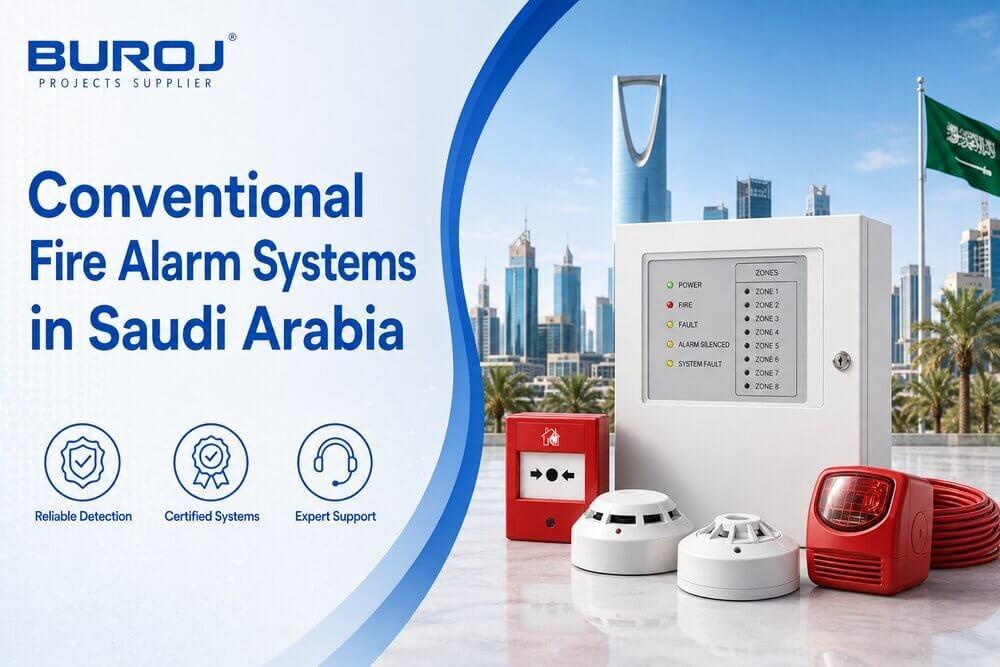
Fire safety is essential for every building in Saudi Arabia. Conventional Fire Alarm Systems offer a reliable and cost-effective solution for small to medium-sized facilities such as warehouses, schools, retail units, mosques, and residential buildings. El Buroj provides certified systems designed, supplied, and installed to meet Saudi Civil Defense requirements and relevant international standards.
What Are Conventional Fire Alarm Systems?
Conventional fire alarm systems are detection and notification networks that divide a building into separate zones, each wired back to a central conventional fire alarm control panel. When a detector or manual call point in a zone activates, the panel indicates which zone has triggered, allowing responders to narrow down the affected area quickly. Unlike addressable systems, conventional setups do not identify the exact device that triggered the alarm, but they are simpler to install, easier to maintain, and more affordable for buildings where zone-level information is sufficient.
How Conventional Fire Alarm Systems Work
Understanding the detection sequence helps facility managers and safety officers make better decisions about system layout and zone planning.
Step 1: Detection Device Activates
A smoke detector, heat detector, or manual call point detects a fire condition and sends an electrical signal along the wired zone circuit. This triggers the first stage of the alarm response and sets the detection sequence in motion.
Step 2: Signal Travels to the Conventional Fire Alarm Panel
The signal travels through the zone cable directly to the conventional fire alarm control panel. The panel continuously monitors every zone for changes in resistance or voltage that indicate a device has activated, been tampered with, or developed a fault.
Step 3: The Panel Identifies The Alarm Zone
The panel displays the zone number on its indicator, alerting building management and security personnel to the broad area where the alarm originated. For a small building with clearly defined zones such as ground floor, first floor, and warehouse, this information is usually sufficient to locate the incident quickly.
Step 4: Notification Devices Alert Occupants
Sounders, bells, horns, and strobe lights activate simultaneously throughout the building or in selected areas, triggering evacuation protocols. Notification devices are wired to the panel and may be programmed to operate in stages, for example, alert mode first, then full evacuation, depending on building type and local fire safety procedures.
Step 5: Integration Signals Can Trigger Other Systems
Modern conventional panels support relay outputs that can trigger linked systems, including emergency lighting, HVAC shutdown, elevator recall, access control door release, and fire suppression systems. This integration capability makes conventional fire alarm systems a practical backbone for a broader building safety setup.
Main Components of a Conventional Fire Alarm System
A complete conventional fire detection setup relies on several interconnected components, each playing a specific role in early warning and occupant notification.
Conventional Fire Alarm Control Panel
The control panel is the nerve center of the entire system. It monitors all connected zones, displays fault and alarm conditions, powers the detection circuit, and activates notification devices. Panel size ranges from 2-zone units suitable for small offices to 16-zone or larger panels for multi-floor commercial buildings.
Smoke Detectors
Optical (photoelectric) and ionization smoke detectors are the most common detection devices. Optical detectors respond quickly to slow-burning, smouldering fires, while ionization types are faster at detecting fast-flaming fires. The correct type is selected based on the area's risk profile, ceiling height, and ventilation conditions.
Heat Detectors
Heat detectors activate when a room temperature rises above a set threshold (fixed temperature) or increases too rapidly (rate-of-rise). They are preferred in kitchens, boiler rooms, and vehicle parking areas where smoke detectors may produce false alarms from steam, dust, or exhaust fumes.
Manual Call Points
Also called break-glass units or pull stations, manual call points allow occupants to trigger the fire alarm manually when they spot a fire before automatic detectors activate. They are positioned at exit routes and stairwells in compliance with NFPA 72 and Saudi Civil Defense placement requirements.
Sounders, Bells, Horns, and Strobes
Notification devices produce audible and visual alerts to initiate evacuation. Sound output must reach a minimum level above ambient noise, typically 65 dB(A) at the bedhead in sleeping areas, and strobes are required in areas occupied by people with hearing impairments, in line with EN54-3 and local accessibility standards.
Fire Alarm Cables and End-of-Line Resistors
Conventional systems use dedicated fire-rated cables, typically 1.5 mm or 2.5 mm screened cables, that maintain circuit integrity during a fire for a specified period. End-of-line resistors are fitted at the last device in each zone loop, enabling the panel to detect open-circuit faults and short circuits independently of an alarm condition.
Backup Power and Batteries
Saudi Civil Defense regulations require that fire alarm systems operate continuously during a mains power failure for a minimum period, typically 24 hours in standby, followed by 30 minutes in full alarm. Sealed lead-acid batteries housed within the panel provide this backup and are monitored automatically for charge condition.
Interface Relays and Modules
Relay modules allow the fire alarm panel to send switching signals to third-party systems such as HVAC controls, lift controllers, gas suppression systems, and emergency lighting panels. This enables a coordinated building-wide safety response from a single conventional panel trigger.
Browse our full fire alarm and safety systems catalog or contact our team directly for a quotation.

Conventional vs Addressable Fire Alarm Systems
Both system types offer reliable fire detection, but they suit different building sizes and budget structures. The comparison below highlights the key differences to help you choose the right solution.
Conventional Fire Alarm System
- Zone Identification: Zone only, no exact device location.
- Cost: Lower upfront cost.
- Best For: Small to medium buildings.
- Wiring: Zone-based loop wiring.
- Maintenance: Simple, requires less specialist skill.
- Scalability: Limited; adding zones increases cost.
Addressable Fire Alarm System
- Zone Identification: Pinpoints the exact device and location.
- Cost: Higher upfront cost.
- Best For: Large or complex facilities.
- Wiring: Individual device addressing.
- Maintenance: Requires more technical knowledge.
- Scalability: Easily expandable.
When Should You Choose Conventional Fire Alarm Systems?
Conventional technology is the right choice in several common scenarios across Saudi Arabia:
- Small to medium buildings with clearly defined zones (under 10,000 sqm total area)
- Budget-sensitive projects where lower upfront cost is a priority
- Facilities with simple layouts such as single-story warehouses, workshops, or small mosques
- Buildings where existing conventional fire alarm systems infrastructure is already installed, and replacement is not yet justified
- Projects requiring fast installation timelines with straightforward commissioning
- Temporary or modular structures that may be reconfigured regularly
Read: Fire Alarm System Installation in Saudi Arabia: Complete Guide 2026
Saudi Arabia Compliance Requirements for Fire Alarm Systems
All fire alarm installations in Saudi Arabia must satisfy a combination of national and international standards. Non-compliance can result in project rejection, fines, and critically increased risk to life.
Saudi Civil Defense Requirements
The Saudi Civil Defense Directorate General (SCDD) sets mandatory requirements for fire detection and alarm systems in all public, commercial, and residential buildings. Systems must be installed by licensed contractors, commissioned with a formal test certificate, and inspected periodically. Civil Defense approval is required before a building certificate of occupancy is issued.
Saudi Building Code and SBC 801
SBC 801, the Saudi Fire Code, governs fire protection design, including alarm system coverage, detector spacing, notification device placement, and emergency power requirements. Compliance is verified during the Civil Defense inspection and forms part of the overall building code approval process for new and renovated structures.
NFPA 72 Fire Alarm Requirements
Saudi Arabia aligns significantly with NFPA 72, the National Fire Alarm and Signaling Code, for technical requirements covering system design, installation, testing, and maintenance. NFPA 72 specifies detector spacing, pathway survivability, power supply capacity, and documentation requirements that project engineers must follow when designing fire alarm systems in the Kingdom.
UL and EN54 Approved Fire Alarm Equipment
Equipment used in Saudi fire alarm installations should carry recognized third-party certifications such as UL (Underwriters Laboratories) or EN54 (the European standard for fire detection and alarm systems). Using certified products ensures the equipment performs to tested standards and supports Civil Defense approval. El Buroj supplies only certified equipment sourced from reputable manufacturers for all conventional fire alarm system projects.
Read A Complete Guide to Fire Extinguisher Types and Uses
Installation, Testing, and Commissioning Process
A professionally executed installation follows a structured process to ensure reliability and compliance:
- Site survey and zone planning: The engineer maps the building, determines zone boundaries, and calculates detector coverage areas per NFPA 72 and SBC 801 spacing rules.
- Cable routing and containment: Fire-rated cables are installed in conduit or cable tray following defined routes to avoid exposure to heat sources or mechanical damage.
- Device installation: Detectors, call points, sounders, and strobes are fitted at specification heights and spacings with all wiring terminated and labeled.
- Panel programming and zone assignment: Each zone is configured at the panel and labeled clearly for the building's floor plan, enabling fast identification during an alarm event.
- Walk test and functional testing: Every device is individually activated to verify correct panel response, sounder activation, and relay output operation.
- Commissioning documentation: A full test report, as-built drawings, and operation and maintenance manual are produced for the client and presented to Civil Defense for inspection.
- Ongoing maintenance: Annual servicing and quarterly inspections ensure the system remains compliant and fully operational throughout its service life.
Read Best Fire Alarm Cable Types & Prices In Saudi Arabia
Conventional Fire Alarm Systems for Different Saudi Project Types
El Buroj supplies and installs conventional fire alarm systems across a wide range of building types throughout Saudi Arabia:
- Warehouses and logistics centers: Wide-area coverage using heat and smoke detectors on high-bay ceilings with addressable zone maps aligned to storage sections.
- Mosques and Islamic centers: Discreet detector placement preserving architectural aesthetics with low-noise sounder options suitable for prayer environments.
- Schools and educational facilities: Zone layouts aligned to classroom blocks with clearly audible notification for rapid, controlled evacuation.
- Retail and commercial units: Cost-effective single or multi-zone systems meeting Civil Defense requirements for tenanted spaces.
- Residential buildings: Apartment block coverage with heat detectors in kitchens and optical detectors in living areas, bedrooms, and corridors.
- Industrial and manufacturing plants: Robust heat and beam detectors selected for dusty or chemical environments with panel integration into site-wide safety systems.
Why Choose El Buroj for Conventional Fire Alarm Systems in Saudi Arabia?
El Buroj provides end-to-end fire alarm solutions, from system design and equipment supply to installation, testing, commissioning, and maintenance. Our team supports projects in line with Saudi Civil Defense requirements, NFPA 72, and SBC 801. We use certified equipment and provide the documentation required for regulatory approval. Our services cover Riyadh, Jeddah, Dammam, Khobar, Makkah, and other locations across Saudi Arabia.
Get a Free conventional fire alarm systems consultation
Get Instant Pricing via WhatsApp send your project details, BOQ, or product list and receive a competitive bulk quotation within minutes.
Request a bulk quotation by phone. Call us: 920031298
FAQs about Conventional Fire Alarm Systems
How many zones does a conventional fire alarm panel support?
Most conventional fire alarm systems panels support between 2 and 16 zones, depending on the model. Larger panels or panel networks can cover multiple zones across sizeable buildings or campuses.
Are conventional fire alarm systems compliant with Saudi Civil Defense requirements?
Yes, when properly designed and installed using certified equipment in line with SBC 801 and NFPA 72, conventional systems meet Saudi Civil Defense requirements and qualify for official building inspection approval.
What is the difference between a smoke detector and a heat detector?
Smoke detectors sense combustion particles in the air and activate early in a fire's development, while heat detectors respond to temperature rise. Heat detectors are preferred in areas where smoke may be present normally, such as kitchens and vehicle workshops.
How often should conventional fire alarm systems be tested and maintained?
Saudi regulations and NFPA 72 recommend, at minimum, an annual full-system test with quarterly visual inspections of devices and panels to ensure continuous operational readiness and maintain civil defense compliance.
Can conventional fire alarm systems integrate with CCTV and access control?
Yes, conventional fire alarm systems panels with relay outputs can trigger CCTV recording events, unlock access control doors for evacuation, and shut down HVAC systems automatically during an alarm, creating a coordinated building safety response.
How do I get a quote for a conventional fire alarm system installation in Saudi Arabia?
Contact El Buroj directly via WhatsApp for instant pricing or call. Our team will assess your building and provide a fully compliant, cost-effective solution.