
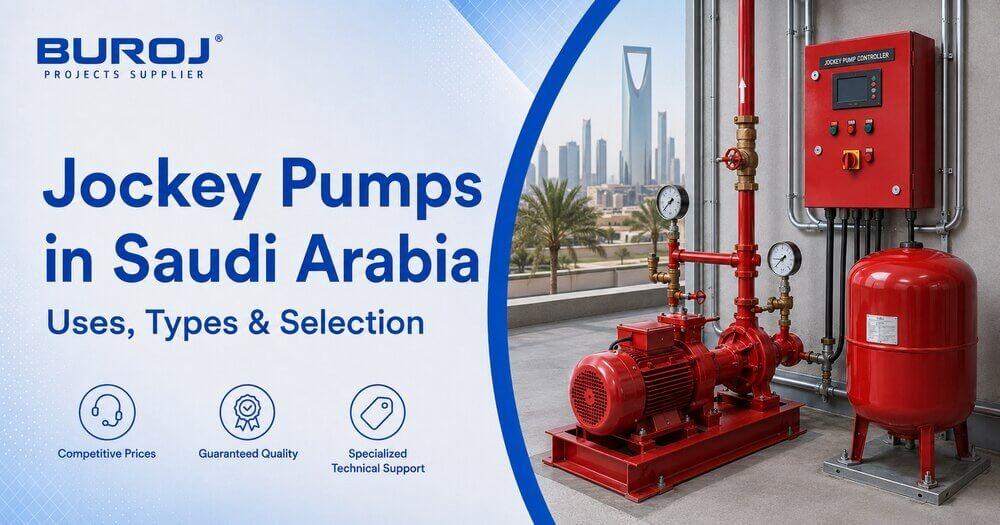
Jockey Pumps a pressure-maintenance pump that keeps a fire protection system within its normal operating pressure range without starting the main fire pump for every minor pressure loss. Its correct selection depends on system pressure, flow, fire pump characteristics, and project requirements. This guide covers uses, types, prices, function, selection criteria, how it differs from a fire pump, and maintenance requirements, drawing on El Buroj's project experience supplying fire pump and pressure-maintenance systems across Saudi Arabia.
What Is a Jockey Pump?
Jockey pumps are a small, automatically controlled pump that maintain fire protection system pressure by compensating for minor leaks and pressure fluctuations, so the main fire pump does not start unnecessarily.
It operates automatically whenever system pressure falls below its configured start point and stops once pressure is restored.
Because a fire protection network is a closed, pressurized system, small leaks at valves, fittings, and seals are normal. The unit is deliberately sized much smaller than the main fire pump, since its role is pressure maintenance rather than firefighting flow, and it shares the fire pump controller's pressure-sensing line but operates on a tighter start-and-stop band, so it responds before the main pump's start point is reached.
What Are Jockey Pumps Used For?
Jockey pumps are commonly used in fire protection systems to maintain system pressure and prevent unnecessary starting of the main fire pump. Their application and configuration should be confirmed against the project design, applicable codes, and authority requirements. Core functions include:
- Maintaining pressure in fire protection piping networks
- Compensating for normal leaks at valves, glands, and fittings
- Preventing unnecessary activation of the main fire pump
- Keeping the system pressurized and ready for an actual fire event
- Maintaining pressure in fire sprinklers and standpipe systems where a jockey pump is specified by the system design.
For example, a small drop caused by a slightly weeping valve gland will typically bring the unit online for a few seconds to restore pressure, after which it shuts off automatically, and the main fire pump never engages for this kind of routine fluctuation.
Types of Jockey Pumps
Selection between configurations depends on required pressure, flow, available plant room space, and site-specific installation constraints.
- Vertical Multistage
- Suitable for compact plant rooms and high-rise buildings.
- Provides high head at low flow with a small footprint.
- Requires a stable foundation and correct priming.
- Horizontal Multistage
- Suitable for ground-level plant rooms and industrial sites.
- Provides easier access for maintenance and inspection.
- Requires more floor space than vertical units.
- Centrifugal (Single Stage)
- Suitable for standard commercial buildings with modest head requirements.
- Offers a simple and cost-effective design.
- Provides less head than multistage models.
Jockey Pumps Price Guide
Jockey pump prices vary depending on capacity, pressure rating, motor power, materials, brand, controller, and project requirements, so there is no single fixed market price. Before comparing prices, check whether the quotation includes:
- Pump
- Motor
- Controller
- Pressure-sensing arrangement
- Valves and accessories
- Base or support arrangement, where applicable
- Installation
- Testing and commissioning
- Required certification and documentation
Two quotations should not be compared by price alone. If one covers a complete project-ready package and the other covers the pump only, the lower unit price may not represent the lower project cost.
Request a consultation today via WhatsApp or call 920031298.

Jockey Pump Function in Fire Protection Systems
The key distinction is simple: the jockey pumps maintain pressure; the fire pump supplies firefighting flow.
How the system responds to a pressure loss
1. System pressure is at its normal operating level.
2. A minor pressure loss occurs.
3. The pump starts.
4. The pump restores system pressure.
5. It stops.
6. A significant fire demand causes the main fire pump to operate according to the system's control sequence.
Jockey Pump vs Fire Pump
A jockey pump maintains pressure during minor losses, while a fire pump supplies the flow required for firefighting. The jockey pump is smaller and handles pressure maintenance, while the fire pump is designed for the higher flow associated with a fire demand.
- Jockey Pump
- Primary purpose: Maintains system pressure.
- Typical flow: Very low.
- Main role: Provides background pressure top-up.
- Activation: Operates in frequent, brief cycles.
- Size: Smaller than the fire pump.
- Firefighting duty: Not intended to supply firefighting flow.
- Fire Pump
- Primary purpose: Supplies firefighting water flow.
- Typical flow: High, based on system demand.
- Main role: Provides active fire suppression supply.
- Activation: Typically operates during a fire demand for sustained periods.
- Size: Larger than a jockey pump.
- Firefighting duty: Specifically designed for firefighting applications.
Neither unit replaces the other, and a fire pump should not be used as a routine pressure-maintenance pump. The two perform different functions within the same fire protection system.
How to Choose the Right Jockey Pump
Selecting the right unit should be based on the actual fire protection system design, not on motor size or price alone.
What information should you have before requesting a quotation?
- Main fire pump rated pressure
- System operating pressure
- Start/stop pressure settings
- Required flow
- System elevation
- Hydraulic calculations
- Pump curve
- Available electrical supply
- Controller requirements
- Project specifications
- Applicable certification requirements
A supplier should be able to review these parameters before recommending a model. This is the type of specification review El Buroj provides for project pump selection, using hydraulic data and pump performance requirements rather than treating the unit as generic off-the-shelf equipment.
Common Selection Mistakes
- Choosing by motor horsepower alone
- Choosing jockey pumps without checking the pressure settings
- Ignoring the main fire pump's pressure characteristics
- Comparing pump prices without comparing package scope
- Oversizing the unit
- Ignoring controller compatibility
- Selecting equipment without checking project specifications
- Treating it as a substitute for the main fire pump
Both undersizing and oversizing can cause problems. An undersized unit may fail to maintain pressure, while an oversized one can interfere with the fire protection system's intended operation sequence. Sizing should always be confirmed against manufacturer specifications and project engineering data rather than a generic formula.
What matters for Saudi Arabia projects?
For Saudi projects, the selection should be checked against the project specification, applicable NFPA requirements, Saudi authority requirements, and the documentation required for approval. Procurement teams should also confirm certification, controller compatibility, manufacturer documentation, and local availability before placing an order, since an approved specification does not necessarily guarantee stock availability or lead time.
Jockey Pump Maintenance
These units require regular inspection, testing, and maintenance to remain ready for service.
Signs the unit needs attention
- Frequent starts
- Failure to restore pressure
- Unexpected pressure fluctuations
- Leakage
- Abnormal vibration or noise
- Controller alarms
- Running longer than expected
Frequent cycling should not simply be treated as normal operation. It can indicate leakage, an incorrect pressure setting, or another system or equipment condition that requires investigation by a qualified technician.
A typical maintenance routine includes visual inspection of the pump and connections, checking for leaks at seals and glands, monitoring pressure against design settings, checking isolation and check valves and controller status, checking electrical connections and motor condition, testing automatic start and stop operation, and keeping maintenance documentation up to date. Intervals should follow applicable standards, manufacturer recommendations, and the site's overall maintenance program rather than a fixed universal schedule, and records should be kept so that any recurring fault pattern is visible at the next inspection.
Why Buy Jockey Pumps from El Buroj
For El Buroj, jockey pump selection starts with the fire protection system rather than the product catalogue. The relevant project data includes the main fire pump's characteristics, required system pressure, flow requirements, hydraulic information, controller configuration, and project specifications.
El Buroj supports contractors and project teams with pump selection, hydraulic sizing, pump curve review, and specification guidance. Its solutions can be selected according to project requirements, applicable standards, and equipment availability, including systems from recognised manufacturers where specified.
For more information about fire pump configurations, project requirements, and available solutions, see El Buroj's fire pump supplier in Saudi Arabia guide.
Request a Project Quote
Need a jockey pump for a new project, replacement, or fire protection system upgrade? El Buroj can support you with product selection, project-specific pricing, and technical requirements.
Visit El Buroj:
For technical selection, project pricing, or bulk orders, contact El Buroj via WhatsApp or call 920031298.
FAQ
What is the purpose of a jockey pump?
A jockey pump maintains constant pressure in a fire protection system, compensating for minor losses so the main fire pump does not start unnecessarily. It keeps piping pressurized and ready between activations of the main pump.
Does a jockey pump run continuously?
No. A jockey pump cycles on and off automatically, starting only when system pressure drops below its configured setting and stopping once pressure is restored; it is not designed for continuous operation.
Can a jockey pump replace a fire pump?
No. A jockey pump only maintains pressure during minor losses; it cannot supply the high flow needed during an actual fire. The main fire pump is required for genuine firefighting demand.
How is a jockey pump sized?
Jockey pump sizing depends on the fire protection system's pressure requirements, flow requirements, expected pressure losses, main fire pump characteristics, and project engineering criteria. Final selection should be confirmed against the system design and applicable requirements.
What happens if the jockey pump fails?
If a jockey pump fails, the fire protection system may lose pressure during minor losses, causing unnecessary main fire pump starts or leaving the system below its intended pressure until the fault is corrected.