
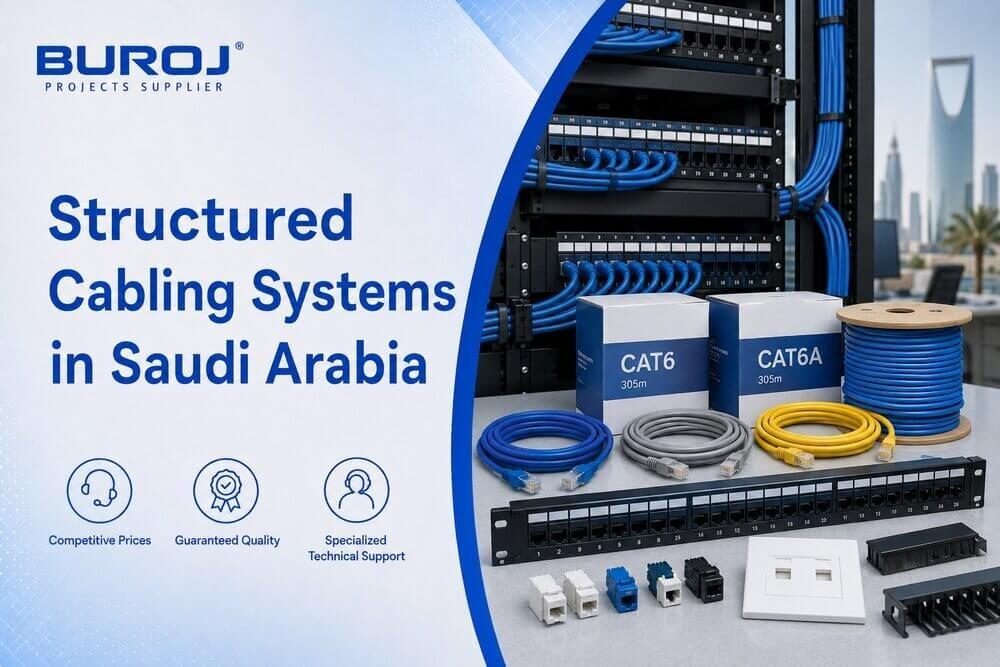
Demand for reliable network infrastructure is rising fast across Saudi Arabia's commercial and industrial projects. Structured cabling systems are the foundation of every modern digital building, carrying data, voice, security, and communication signals through one organized network. As facilities add more connected devices each year, a properly planned cabling backbone becomes a competitive necessity rather than an afterthought. El Buroj supplies structured cabling products and integrated low-current solutions engineered for Saudi Arabia's commercial and industrial market.
What Are Structured Cabling Systems?
Structured cabling is the centralized network infrastructure that connects every data-dependent system in a building through one standardized design. Modern buildings need this centralized approach because scattered point-to-point wiring cannot reliably support data, voice, CCTV, access control, fire alarm, and communication systems at once. A structured design consolidates all of this into a single, manageable network built around consistent standards.
The business case is straightforward: scalability to add devices without rewiring, reliability that reduces downtime, simplified maintenance since technicians work from one documented layout, and lower operating costs over the building's lifetime.
Explore El Buroj's range of Light Current Systems to see how these products support this kind of integrated infrastructure.
Main Components of a Structured Cabling System
A structured cabling system relies on several components working together, and mismatched parts are one of the fastest ways to degrade performance.
- Copper Cabling: carries data and power over shorter runs and remains the standard choice for workstations and access points.
- Fiber Optic Cabling: handles longer distances and higher bandwidth, making it the default for backbone links and data-heavy environments.
- Patch Panels: organize and terminate cable runs at a central point for easy management.
- Network Cabinets: protect active equipment and keep installations tidy and serviceable.
- Connectors & Faceplates: provide the physical interface at each outlet.
- Cable Management Accessories: keep runs organized and protected from damage.
Component compatibility and installation quality matter more than any single product choice, since a weak link anywhere in the chain limits long-term network performance. El Buroj's range of Cables gives contractors a reliable source for copper and fiber cabling on the same order.
Types of Structured Cabling Solutions
Structured cabling falls into a few distinct categories, and choosing the right one depends heavily on project size and distance requirements.
- Copper Cabling: cost-effective for standard office and retail environments where run lengths stay under 100 meters.
- Fiber Optic Cabling: the better choice for larger campuses, data centers, and any application needing high bandwidth over longer distances.
- Horizontal Cabling: connects individual work areas to the nearest distribution point and forms the bulk of any building's network cabling.
- Backbone Cabling: links distribution points and equipment rooms together, carrying the heaviest traffic loads across the facility.
Contractors typically combine copper for horizontal runs with fiber for backbone links on larger commercial and industrial projects.
Applications of Structured Cabling Systems in Saudi Arabia
Structured cabling systems support nearly every commercial and industrial building type in the Kingdom, each with its own infrastructure cabling demands.
- Office Buildings: daily connectivity and future desk reconfiguration without new wiring.
- Hospitals: dependable cabling for critical systems where downtime is not an option.
- Hotels: guest Wi-Fi, property management systems, and security together on one network.
- Schools & Universities: scalable cabling to add classrooms and labs over time.
- Industrial Facilities & Warehouses: connect sensors, control systems, and inventory tracking across large footprints.
- Data Centers: the highest-performance cabling available, since every connection affects business continuity.

Why Structured Cabling Systems Are Essential for Smart Buildings
Structured cabling systems are essential for smart buildings because every connected system, from CCTV to IoT sensors, depends on the same reliable network backbone.
- CCTV and access control systems need consistent bandwidth and power delivery to function without dropouts.
- Fire alarm systems require dedicated, reliable pathways since any downtime is a safety risk.
- Wi-Fi networks depend on a strong cabled backbone to deliver coverage across every floor.
- Building management systems and IoT devices multiply the number of connected points in a facility every year, and structured cabling systems are what ties them all together.
El Buroj's guide to earthing installation covers related low-current groundwork that protects sensitive network equipment during setup.
How to Choose the Right Structured Cabling Systems
Choosing the right cabling systems starts with matching the design to building size, bandwidth needs, and future growth plans.
- Building size: larger facilities with data-heavy operations need fiber-capable backbones, while smaller offices can often run on copper alone.
- Bandwidth needs: current and projected data loads determine copper versus fiber requirements.
- Scalability: underbuilding a network means costly rework within a few years.
- Environmental conditions: heat, dust, and humidity common in Saudi industrial sites affect cable selection and pathway design.
- International standards: ANSI/TIA and ISO/IEC give consultants a reliable benchmark during design approval.
- Future upgrades: planning pathway capacity now avoids disruptive retrofits later.
Because so many variables interact, it's worth consulting specialists before purchasing rather than after installation begins. El Buroj offers structured cabling services covering design, product selection, and structured cabling installation from a single point of contact.
Common Mistakes When Installing Structured Cabling Systems
- Poor cable routing: tight bends or paths near power lines degrade signal quality over time.
- Low-quality materials: save money upfront but fail early, especially in Saudi Arabia's heat and dust.
- Lack of labeling: turns simple troubleshooting into hours of tracing cables, driving up maintenance costs.
- Ignoring future expansion: forces a full re-cabling project the moment a facility grows.
- Choosing on price alone: skipping compatibility or certification checks shows up later as downtime and unreliable connections.
Every one of these mistakes increases troubleshooting difficulty and long-term operating expenses well beyond the initial savings. El Buroj's guide to Bahra cables pricing and specifications is a useful reference when comparing cable quality before ordering.
Why Choose El Buroj for Structured Cabling Systems in Saudi Arabia?
El Buroj supplies structured cabling solutions backed by trusted manufacturers, technical consultation, and full engineering support from design through procurement accross Saudi Arabia with:
- Trusted manufacturers for copper, fiber, and cabling accessories.
- Technical consultation to help you select the right products for your project.
- Competitive wholesale pricing for bulk orders and large projects.
- Fast delivery across Saudi Arabia to help keep projects on schedule.
- Engineering support from product selection through procurement.
- Solutions suitable for commercial, industrial, government, hospitality, and healthcare projects.
Visit El Buroj to explore the full catalogue of low-current and structured cabling products, request a wholesale quotation or contact the technical team via WhatsApp, or 920031298.
Frequently Asked Questions
What is the difference between structured cabling and network cabling?
Structured cabling refers to the complete organized system, including panels, cabinets, and pathways. Network cabling typically refers to the cables themselves. In practice, network cabling is one component of a full structured design.
How much does structured cabling installation cost?
Cost depends on building size, cable type, distance, and labor complexity. El Buroj recommends a site assessment and customized quotation, since fixed pricing rarely reflects actual project requirements.
Which structured cabling system is best for commercial buildings?
Most commercial buildings use copper for horizontal runs and fiber for backbone links. The best combination depends on building size, bandwidth needs, and expected future expansion.
Can structured cabling systems support CCTV and access control?
Yes. A properly designed cabling network carries CCTV, access control, and other low-current systems on the same reliable backbone, simplifying both installation and long-term maintenance.
How long does structured cabling last?
Quality structured cabling typically lasts 15 to 25 years when installed correctly and protected from environmental damage, making it a long-term infrastructure investment rather than a recurring cost.
Why should businesses invest in structured cabling services?
Professional structured cabling services reduce downtime, simplify maintenance, and support future growth without costly rewiring, making them a practical investment for any commercial or industrial project.