
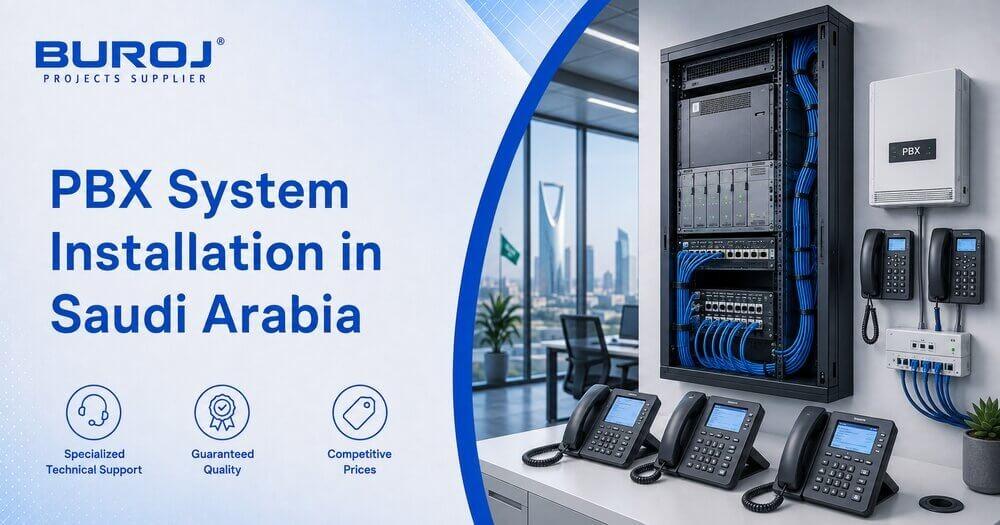
Reliable communication directly shapes productivity, customer experience, and daily operations. A dependable PBX system is no longer just a telephone setup; it is core business infrastructure that keeps teams connected and calls professional. As Saudi businesses scale, the right communication backbone becomes a competitive advantage. El Buroj is a trusted provider of business communication and low-current solutions across the Kingdom, supporting design through installation, including its Light Current Systems range.
What Is a PBX System?
A PBX, or Private Branch Exchange, is a private telephone network that manages internal and external calls for a business. Instead of every phone connecting directly to the public network, a PBX routes calls internally first, cutting communication costs and giving every team professional call handling. Employees can transfer calls and reach colleagues without dialing outside lines, which means better collaboration across departments and noticeably higher productivity.
Types of PBX Systems
Businesses can choose from four main deployment models, each suited to different needs and budgets.
- Traditional PBX: on-site hardware and physical phone lines, favored by organizations wanting full local control.
- IP PBX: runs calls over the internet using VoIP, offering lower running costs and easier scaling.
- Hosted (Cloud) PBX: moves the platform off-site, removing hardware maintenance and letting remote teams connect from anywhere.
- Hybrid PBX: blends traditional lines with IP technology for businesses transitioning gradually.
Smaller offices often start with IP PBX for its low upfront cost, while larger enterprises frequently choose hybrid setups for flexibility during expansion.
Understanding the Modern Private Automatic Branch Exchange (PABX)
A modern private automatic branch exchange, or PABX, is today's automated version of the PBX, built around VoIP rather than analog lines. A PABX telephone system supports centralized management from a single dashboard, so IT teams can add extensions or adjust routing without touching hardware at every desk.
PBX Phone System Features
A capable PBX phone system does far more than route calls; it shapes daily customer and staff experience.
- Auto Attendant & IVR: route callers to the right department without a receptionist, cutting wait times and staffing costs.
- Call Forwarding & Recording: keep staff reachable and support quality control and dispute resolution.
- Voicemail & Conference Calling: keep messages accessible and remote teams connected without extra software.
- Remote Extensions & Mobile Integration: let staff answer their office number from anywhere, keeping response times fast.

PBX System Installation Process
Every installation follows a structured path designed to minimize downtime and ensure long-term reliability.
- Requirements assessment and network evaluation to confirm infrastructure can support VoIP traffic.
- System design mapping extensions, call flows, and integrations.
- PBX Installation and configuration tailored to the agreed design.
- Testing to confirm call quality and failover behavior.
- User training and a maintenance plan to keep performance steady long-term.
IP PBX Installation vs Traditional Telephone System Installation
IP PBX Installation and Telephone System Installation differ in cost, flexibility, and scalability, as shown below.
Infrastructure:
- IP PBX Installation: Uses existing internet connection.
- Traditional Telephone System Installation: Requires dedicated phone lines.
Scalability:
- IP PBX: Add users through configuration.
- Traditional Telephone System: Add users through new wiring.
Maintenance:
- IP PBX: Centralized and often managed remotely.
- Traditional Telephone System: Requires on-site hardware servicing.
Cost of Ownership:
- IP PBX: Lower cost over time.
- Traditional Telephone System: Higher costs due to hardware and phone lines.
Flexibility:
- IP PBX: Supports remote and mobile staff.
- Traditional Telephone System: Limited to fixed locations.
Remote Work:
- IP PBX: Fully supports remote work.
- Traditional Telephone System: Does not natively support remote work.
Expansion:
- IP PBX : enables fast expansion with minimal disruption.
- Traditional Telephone System: may require rewiring.
Reliability:
- IP PBX: depends on internet quality.
- Traditional telephone systems: operate independently of an internet connection.
Most organizations in Saudi Arabia now favor IP PBX Installation for its lower cost and easier expansion, though traditional systems still suit sites with unreliable internet.
Office Phone System Solutions by Business Size
Matching the right PBX system to headcount, growth plans, and location count is the core of any office phone system decision.
- Small Offices: a simple IP PBX or hosted plan covering a handful of extensions keeps upfront costs low.
- Medium Businesses: need more advanced routing and CRM integration, pointing toward a scalable IP or hybrid setup.
- Large Enterprises: usually require a distributed architecture connecting several branches with redundancy against failure.
Planning for growth over the next three to five years avoids a costly redesign later.
PBX System Integration
A modern PBX system becomes far more valuable once it connects with the rest of a building's smart infrastructure rather than working in isolation.
- Integration with CCTV: lets security teams verify a caller's identity visually before granting access.
- Access control integrations: means front-desk staff can unlock doors remotely during a call, streamlining visitor management.
- Public address systems: can share the same network, allowing emergency announcements to reach every zone from one interface.
- CRM integration: pulls customer history onto the agent's screen the moment a call connects.
- Building Management Platforms: tie communication into HVAC, lighting, and security for centralized control.
These integrations bring real advantages: centralized management, automation that reduces manual tasks, stronger security through cross-system verification, and a better customer experience.
El Buroj's guide to intercom systems in Saudi Arabia covers a closely related integration, showing how visitor communication and access control work together.
PBX System Costs in Saudi Arabia
Costs vary widely because so many project-specific factors are involved, so fixed pricing rarely applies.
- Number of users and extensions
- PBX type: traditional, IP, hosted, or hybrid
- Required features such as call recording or mobile integration
- Condition of existing infrastructure
- Integration requirements with CCTV, access control, or CRM
- Installation complexity across multiple sites
- Future scalability plans
Designing for growth now is cheaper than a redesign later. El Buroj recommends requesting a customized quotation rather than relying on general estimates.
How to Choose the Best PBX System
- Choosing the right solution starts with an honest look at business size, budget, and where the company expects to be in a few years.
- Required integrations, such as CCTV, access control, or CRM, should shape the shortlist early.
- Vendor support and after-sales service matter as much as the hardware, since a fast response during downtime protects revenue.
- Expansion capability deserves attention too: a setup that can't grow becomes a costly replacement project within a few years.
El Buroj's guide to public address system solutions in Saudi Arabia is a useful reference for anyone evaluating connected communication infrastructure.
Consulting a specialist before selecting a solution remains the most reliable way to avoid an expensive mismatch.
Best PBX Brands
Several manufacturers have earned strong reputations in the Saudi market. Panasonic is known for dependable hardware, Yeastar offers flexible IP PBX platforms popular with small and medium businesses, Grandstream provides cost-effective VoIP hardware, Avaya suits larger call centers, and Cisco fits businesses already on Cisco networking. Evaluation should weigh reliability, feature depth, local support, and integration capability, since no single manufacturer suits every project.
Why Businesses Choose El Buroj for PBX System Installation
El Buroj brings deep Saudi market expertise to every project, from system design through supply, installation, configuration, and testing. The team handles technical consultation from the first conversation, matching features to actual needs rather than overselling capacity.
Integration with low-current systems, including CCTV, access control, and public address, is handled in-house, avoiding the coordination gaps that slow down multi-vendor projects. Competitive wholesale pricing keeps costs predictable, and ongoing support after installation keeps performance steady as the business grows.
Visit one of our El Buroj branches in Saudi Arabia for expert consultation and the latest communication and low-current solutions:
Get instant pricing via WhatsApp, request a bulk quotation, or speak with a PBX specialist at 920031298 to plan your project. Request a free consultation or a site assessment, and our team will recommend the right setup for your business.
FAQs about PBX Phone System
What is the difference between PBX and IP PBX?
Traditional PBX uses physical phone lines and on-site hardware, while IP PBX routes calls over the internet using VoIP, offering lower costs and easier scaling.
Is a PBX System suitable for small businesses?
Yes. Small offices can start with a low-cost IP or hosted setup covering a few extensions, then scale up as the business grows.
Can a PBX integrate with CCTV and access control?
Yes. Modern platforms connect with CCTV and access control to verify visitors before granting entry, giving staff one interface for communication and security.
How much does installation cost in Saudi Arabia?
Cost depends on user count, PBX type, features, and integration needs. El Buroj recommends a customized quotation, since fixed pricing rarely reflects actual requirements.
What is the lifespan of a PBX phone system?
A well-maintained platform typically lasts 8 to 12 years, though IP-based systems often stay current longer through software updates.