
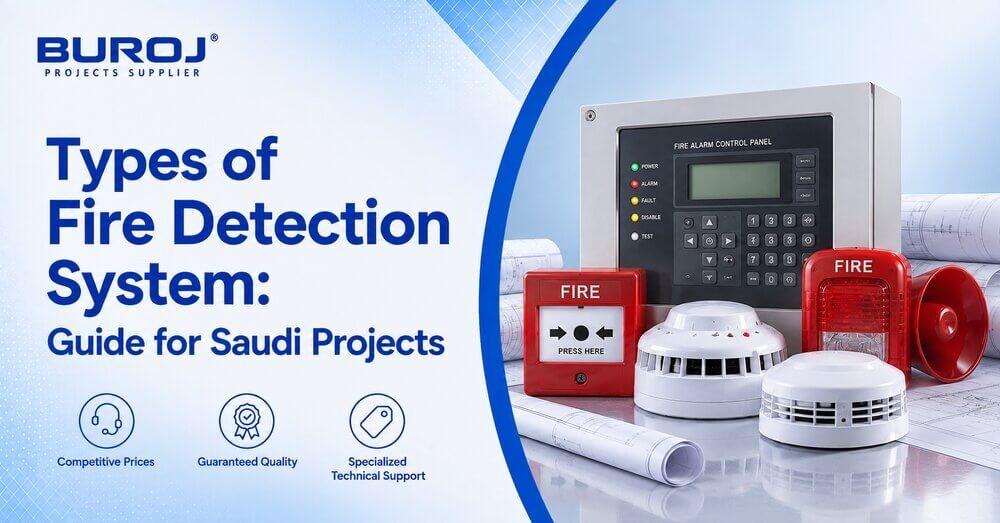
Choosing between types of fire detection system starts with one question: what will the detector actually sense in that space? Smoke, heat, and flame each behave differently, and a detector that suits an office will false alarm in a kitchen or miss a fire in a warehouse. This guide covers how detection works, the system and detector types available, and the requirements that apply on Saudi projects.
What Is a Fire Detection System and How Does It Work?
A fire detection system senses one of the products of combustion and reports it to a control panel.
The sequence:
- A detector senses smoke particles, a rise in temperature, or light from a flame
- The detector sends a signal to the control panel
- The panel confirms the signal against its programmed logic
- The panel triggers sounders, strobes, and any linked building actions
- HVAC shuts down, dampers close, doors release, and lifts return to ground level
What Are the Main Types of Fire Detection System?
Systems are grouped by how the detectors communicate with the control panel. That single design decision affects installation cost, how quickly a fault is traced, and how far the system can expand later. These are the main types of fire detection system used on commercial and industrial projects:
- Conventional: detectors are wired together in zones, with each zone on its own circuit back to the panel. When a detector activates, the panel shows the zone rather than the device, so responders check every detector in that zone to find it. The lowest cost option, and suitable for small buildings with a handful of zones.
- Addressable: every detector carries a unique address on a loop, so the panel names the exact device along with its programmed location text. One loop carries far more devices than separate zone circuits, which cuts cabling. The standard choice for medium and large buildings.
- Intelligent (analog addressable): detectors report a measured value rather than a simple alarm or normal state, and the panel decides whether that reading represents a fire. This allows pre-alarm warnings, automatic compensation as detectors collect dust, and different sensitivity settings by time of day. The fewest false alarms, at the highest cost per device.
- Wireless: a radio link replaces the cabling between detectors and the panel, with battery powered devices. Useful where cabling is difficult or destructive, such as heritage buildings and completed fit-outs. Needs a radio survey during design and battery replacement as a scheduled task.
- Hybrid: wired and wireless devices on one platform, or existing conventional zones connected to an addressable panel through interface modules. The practical answer for extensions and phased projects, where replacing working equipment is not justified.
Choosing between these types of fire detection system settles how the building is wired and how fast a fault is located. It does not settle whether the fire is detected at all, and that depends entirely on the detector technology covered next.

Types of Fire Detectors and How They Work
This is where most project decisions are actually made. The main types of fire detectors:
- Optical (photoelectric) smoke: a light beam inside the chamber scatters when smoke enters. Best for slow, smouldering fires. The default for offices, corridors, and bedrooms.
- Ionisation smoke: senses the change in a small ionised current when combustion particles enter. Responds faster to fast-flaming fires. Less common today.
- Multi-sensor: combines smoke and heat sensing in one unit and weighs both readings. Fewer false alarms in mixed environments.
- Fixed-temperature heat: alarms when the air reaches a set temperature. Simple and reliable.
- Rate-of-rise heat: alarms when temperature climbs quickly, even before the fixed threshold. Faster than fixed temperature alone.
- Flame detectors: sense ultraviolet or infrared light from flames. Very fast, but need a clear line of sight to the fire.
- Beam detectors: a transmitter and receiver across a wide space. Smoke crossing the beam reduces the signal. Used in atriums and warehouses.
- Aspirating detection: a fan draws air samples through pipework to a central sensor. The earliest warning available, used in data centers and high-value areas.
- Duct detectors: installed inside HVAC ducts to stop smoke spreading through the air system.
- Linear heat cable: a cable that detects heat anywhere along its length. Used in cable trays, tunnels, and conveyor systems.
El Buroj supplies detectors across these categories, along with panels, call points, and sounders, with datasheets and approval certificates ready for submittal.
Read more: Fire Alarm Systems Installation in Saudi Arabia: Complete Guide 2026
Smoke vs Heat vs Flame Detectors: What Is the Difference?
The three sense different things, and each trades speed against reliability.
Smoke detectors:
- Sense particles, so they react before a fire produces much heat
- The fastest option for smouldering fires in normal occupied spaces
- False alarm in dust, steam, cooking fumes, and vehicle exhaust
Heat detectors:
- Sense temperature, so they only alarm once the fire is established
- Slower than smoke, and not suitable for life safety on their own in most spaces
- Reliable where smoke detectors cannot work: kitchens, car parks, boiler rooms, workshops
Flame detectors:
- Sense the light signature of a flame, responding in seconds
- Best for fast-flaming fuel and chemical fires
- Need a direct line of sight, so obstructions and dirty lenses defeat them
How to Choose Between Types of Fire Detection System Solutions
Six questions narrow the choice between types of fire detection system options:
- What is in the space? The fuel decides whether the first sign will be smoke, heat, or flame.
- What is the environment like? Dust, steam, fumes, and extreme temperatures rule out smoke detection.
- How high is the ceiling? Point detectors have a maximum mounting height. Beam or aspirating detection covers higher spaces.
- How fast must it respond? A data center needs warning far earlier than a storeroom.
- What is the building size? Under roughly 40 devices, conventional usually costs less. Above that, addressable wins.
- What does the specification say? If it names a system type or a standard, that decision is already made.
Read more: Conventional Fire Alarm Systems in Saudi Arabia
Fire Detection System Requirements in Saudi Arabia
Meeting the technical brief is not enough. The system also has to pass approval and arrive with the right documents.
Saudi Fire Protection Code – SBC 801
- Sets what detection a building needs based on occupancy type, height, and risk level
- Defines the level of coverage required for each occupancy class
- References international standards for the technical detail
- Occupancy class should be confirmed before any detector or panel is selected
Saudi Civil Defense Requirements
- Civil Defense is the approval authority, and no building receives its safety licence without their acceptance
- Design drawings are submitted for review before installation starts
- A site inspection is carried out before the licence is issued
- Equipment is expected to carry recognised approvals such as UL or FM
- Larger and higher-risk buildings are normally specified as addressable
Common Mistakes When Selecting Fire Detection Systems
These mistakes surface at commissioning, at Civil Defense inspection, or during the first false alarm — rarely at installation:
- Fitting smoke detectors where the air is not clean: kitchens produce cooking fumes, car parks produce exhaust, and workshops produce dust. Each of these triggers an optical smoke detector the same way smoke does. The result is repeated false alarms, which ends with staff disabling the zone. Heat or multi-sensor detection belongs in these spaces.
- Ignoring the maximum mounting height: every point detector is listed for a maximum ceiling height. Above it, smoke cools and spreads before it reaches the detector, so the alarm comes late or not at all. High spaces need beam or aspirating detection, not more point detectors.
- Leaving voids undetected: the area above a false ceiling and below a raised floor carries cables and ducts, and a fire can start in either. Detecting only the visible room means the fire develops unseen until it breaks through.
- Fitting a single detector where two are required: any system that releases suppression needs confirmation from two independent detectors before discharge. A single detector means one dust event can empty a gas cylinder or flood a room.
- Handing over with no testing schedule: detectors collect dust, batteries expire, and sensitivity drifts. A system that passed commissioning can be incapable of detecting a fire two years later while still showing normal on the panel.
How El Buroj Supports Fire Detection Projects in Saudi Arabia
- Design support: detector selection matched to the space, with zone and loop design
- Supply: panels, detectors, call points, sounders, and modules with approval certificates
- Installation and integration: device installation, panel configuration, and links to HVAC, lifts, and doors
- Testing and commissioning: logged device testing and support during Civil Defense inspection
- Maintenance: scheduled visits, fault response, and spare parts held inside the Kingdom
Get the best fire detection systems for your project at the best price from El Buroj. Send your drawings or bill of quantities and receive project pricing. Call 920031298 or contact us on WhatsApp.
Read more: Top Fire Alarm System Suppliers in Saudi Arabia 2026
FAQs About Types Of Fire Detection System
What are the three main types of fire detection systems?
Conventional, addressable, and wireless. Intelligent analog addressable and hybrid are the other two fire detection system types commonly specified.
What are the different types of fire detectors?
Optical and ionisation smoke, fixed-temperature and rate-of-rise heat, flame, multi-sensor, beam, aspirating, duct, and linear heat cable.
What are the types of fire systems?
Detection and alarm, water-based suppression such as sprinklers and hydrants, gaseous suppression, and portable extinguishers. Detection is the part that senses the fire; the others control or extinguish it.
What kind of types of fire detection system is best?
There is no single best detector. Smoke detection suits clean occupied spaces, heat suits kitchens and car parks, flame suits fuel hazards, and aspirating detection suits data centers.