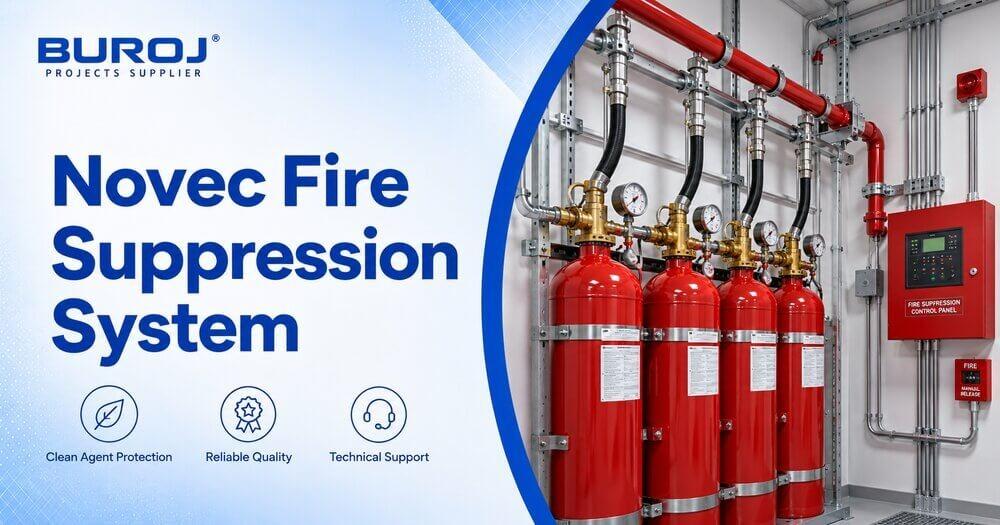
A Novec fire suppression system puts out fires in enclosed spaces with a clean agent instead of water, so sensitive equipment stays undamaged. Novec-type systems are commonly considered for Saudi projects involving data centers, server rooms, electrical rooms, and control rooms, where water or powder could damage equipment. El Buroj supports contractors and consultants from equipment selection to supply, installation, testing, and commissioning.
What Is a Novec Fire Suppression System and How Does It Work?
A Novec fire suppression system is a total-flooding clean-agent system that uses FK-5-1-12 to extinguish fires in enclosed spaces without water or conventional extinguishing residue. It typically combines detection, a releasing panel, agent cylinders, piping, and discharge nozzles:
- Terminology: Novec 1230 is the trade name of a fluoroketone fire protection fluid, and FK-5-1-12 is its generic designation in clean-agent standards such as NFPA 2001 and ISO 14520, and it remains the designation used for new systems now that the branded fluid has been discontinued by its manufacturer.
- The agent: stored as a liquid, pressurized with nitrogen, and vaporizes as it discharges.
- How it extinguishes: it absorbs heat from the flame, not by removing oxygen, and it evaporates instead of leaving conventional residue.
The operating sequence runs in five steps:
- Detection of the fire
- Alarm and pre-discharge delay
- Activation and agent discharge
- Fire suppression
- Post-discharge ventilation and recovery

What Are the Components of a Novec 1230 Fire Suppression System?
Each component has a defined role, and the exact set depends on the system design.
- Agent storage cylinders and valves: hold the pressurized FK-5-1-12 agent and release it on a panel signal, sized to the protected volume.
- Discharge piping and nozzles: carry and distribute the agent, with nozzle position affecting distribution and discharge time.
- Releasing control panel: processes detector signals and runs the alarm, delay, and discharge logic.
- Detection devices: usually smoke detectors, often cross-zoned where the project design requires it.
- Alarm devices, manual release and abort stations: warn occupants and allow manual activation, with an abort function where the design includes one.
- Pressure monitoring: shows cylinder status so a loss of pressure is noticed.
- Room integrity provisions and building interfaces: sealing, dampers, pressure relief, HVAC shutdown, door release and connection to the main fire alarm system.
Novec Fire Suppression System Design Requirements
The design of a Novec fire suppression system depends on the protected volume, the hazard, the design concentration, the enclosure characteristics and the applicable standards.
The required Novec system agent quantity depends on the protected volume and design conditions, not simply on the room's floor area. Ceiling height, voids, room temperature, and hazard class all change the calculation.
Designers also resolve :
- Cylinder sizing and piping layout
- Nozzle placement and discharge time
- Enclosure integrity and pressure relief
- HVAC shutdown and release logic
- Occupant safety
NFPA 2001 is a recognized technical reference, but it is not the whole Saudi framework:
- Saudi Civil Defense requirements
- Saudi Building Code provisions where applicable
- The consultant's specification must also be checked.
- Detection and release logic should be coordinated with the project's fire alarm systems.
Where Is a Novec 1230 System Used?
Novec-type clean-agent systems are generally used where fire suppression is required, but water, foam or powder could damage sensitive assets or interrupt operations.
- Data centers, server rooms and telecommunications rooms
- Electrical, switchgear and UPS rooms, where appropriate
- Control rooms and industrial control environments
- Archives and valuable-content rooms, where appropriate
Not every one of these spaces automatically requires Novec; selection depends on the hazard, enclosure, occupancy and applicable requirements. Water-based protection for the wider building, such as fire sprinklers, is designed as a separate system.
Novec 1230 Fire Suppression System for Data Centers and Server Rooms
Data centers and server rooms are the typical fit for a Novec fire suppression system because the agent extinguishes a fire without water and without damaging the equipment inside.
The same reasoning applies to other rooms listed above, such as telecommunications, electrical, and control rooms: they house equipment that water would destroy and operations that cannot stop for long. In these spaces, the extinguishing process itself should not cause the damage the fire would have caused.
That is why clean-agent suppression is considered here first, and why it works best as part of a coordinated arrangement:
- Rapid discharge limits fire growth around critical assets
- No water and no conventional residue on electronic equipment
- Early detection, pre-discharge warning, and HVAC shutdown work together with the suppression system
- Room integrity keeps the agent in the space long enough, and a recovery procedure follows discharge
No system guarantees zero downtime or zero damage, so it must be engineered for the specific space and its airflow.
Novec 1230 vs FM200 vs Inert Gas Systems
Each technology suits different projects, and none is the best choice in every case
- Novec / FK-5-1-12: a fluoroketone stored as a liquid and discharged as a vapor. It can be designed for occupied spaces when the agent concentration, enclosure, warning sequence and applicable safety requirements meet the relevant design criteria, and it leaves no conventional residue. Cylinder-storage requirements depend on the protected volume, design concentration, cylinder capacity and system configuration.
- FM-200 / HFC-227ea: a hydrofluorocarbon agent used in similar applications and system layouts. HFCs are subject to phasedown policies in several jurisdictions, so project teams should consider current availability and long-term lifecycle requirements when specifying the system.
- Inert gas systems: blends of nitrogen, argon or both, which extinguish by lowering the oxygen concentration in the room. They are stored as high-pressure gas, so cylinder space, pipe pressure and room pressure relief need early coordination.
Which factors should determine the choice? The hazard, protected volume, occupancy, equipment sensitivity, available cylinder space, discharge requirements, room integrity, authority requirements, the project specification, lifecycle considerations, and current agent availability.
Read more:
FM-200 System: Design, Installation & Cost Guide
Fire Fighting Equipments Supply & Installation in Saudi Arabia
How to Choose a Novec System for Your Project
The right system is the one that fits the room volume, hazard, and approved specification, not the one with the lowest cylinder price. Work through these in order:
- Start with room volume: it sets the agent quantity and cylinder count, and it is the largest cost driver
- Confirm the room can be sealed: an agent that leaks out in a minute will not extinguish a fire that needs ten
- Read the specification before the catalogue: if it names a standard or a listing, the decision is already made
- Verify the system listing, not the part: approval covers the assembly, and mixing manufacturers voids it
- Price the lifecycle, not the installation: refilling after any discharge is a recurring cost
- Check local support: spare parts and refilling service available inside the Kingdom
Before approving any system, request the technical submittal, datasheets, system calculations, certificates or listings, and a written scope covering supply, installation, testing and commissioning.
Novec Fire Suppression System Design, Supply & Installation by El Buroj
El Buroj approaches clean-agent suppression as a complete project system rather than a collection of individual components.
- Equipment selection and system configuration matched to the approved specifications
- Design coordination with consultant requirements
- Supply of the system equipment
- Installation, testing, and commissioning within the agreed scope
- Project documentation and maintenance support
Send El Buroj the project specification, BOQ, room dimensions or equipment schedule to review the required scope and prepare a project-specific quotation.
How Is a Novec System Tested and Commissioned?
Installation puts the equipment in place, while commissioning proves that the system works as designed.
- Visual inspection of cylinders, valves, piping, and nozzles
- Testing of detection, releasing circuits, and alarm sequence
- Manual release and abort function checks, where installed
- HVAC interface testing and system logic verification
- Commissioning records and documentation for the consultant or authority
A full agent discharge in every protected room is not routine; test methods depend on the system design, project specifications, and applicable standards.
Novec System Maintenance, Refilling and Lifecycle Considerations
Maintenance keeps a clean-agent system ready to operate, and lifecycle planning keeps it serviceable.
A fire suppression system can sit unused for years and must work the first time it is needed, which is why regular maintenance matters. It covers the cylinders and pressure status, valves, piping, nozzles, detection devices, the releasing panel, alarms, room integrity, and service records. After a discharge, the cylinders and agent supply must be restored according to the system manufacturer’s requirements and applicable standards.
El Buroj supports maintenance and refilling needs within the agreed project scope, so the system stays aligned with its original design and project requirements.
What Determines Novec Fire Suppression System Cost in Saudi Arabia?
The cost of a Novec fire suppression system is set per project, because it depends on the protected volume, system configuration, and project scope, not on a standard package.
A Novec fire suppression system cannot be accurately priced from room area alone because the agent quantity and system configuration depend on the protected volume and engineering requirements. Exact pricing requires project information and a quotation.
The main cost factors are:
- Protected room volume, agent quantity, and number and size of cylinders
- Piping length, number of nozzles, detection, releasing panel and interface requirements
- Room integrity requirements and installation complexity
- Testing and commissioning scope, documentation, and certification or listing requirements
- Project location, delivery, and authority or consultant requirements
- Supply-only scope versus installation and commissioning, and new systems versus refilling
Send El Buroj the room dimensions, project specifications, BOQ, or required system scope to request a project-specific quotation.
Common Novec System Design and Procurement Mistakes
Most problems start with early decisions made before the engineering is complete.
- Choosing a system on cylinder price alone, or comparing only initial purchase price
- Sizing by floor area instead of protected volume
- Ignoring room integrity, pressure relief, and occupant safety
- Failing to coordinate HVAC shutdown, or treating detection and suppression as separate systems
- Choosing equipment without checking approvals or listings
- Assuming “Novec 1230” and generic FK-5-1-12 are interchangeable without checking system compatibility and approvals
- Leaving testing and commissioning scope undefined, or accepting incomplete technical documentation
- Ignoring refilling and agent availability over the system's life
Need a Novec fire suppression system for a Saudi project? Send El Buroj your project specifications, room dimensions, BOQ, or equipment requirements to receive a project-specific quotation.
- Phone: 920031298
- WhatsApp: +966 53 496 4817
FAQs About Novec Fire Suppression Systems
What is the Novec fire suppression system?
It is a clean-agent system that discharges FK-5-1-12 fluid through fixed piping and nozzles to extinguish fires in enclosed spaces. It is used where water could damage sensitive equipment.
What is the difference between Novec and FM-200?
Novec is generally seen as the more environmentally friendly option and is often chosen for occupied technical rooms, while FM-200 is a long-established alternative. Novec agent typically costs more, so the right choice depends on the project and the quotation.
Which gas is used in Novec?
Novec 1230 is associated with FK-5-1-12, a fluoroketone clean agent. It is stored as a liquid under pressure and vaporizes when discharged into the protected space.
How does Novec work?
It discharges a clean agent that stops the fire without water, so sensitive equipment is not damaged by the extinguishing process. The agent vaporizes, absorbs heat from the flame, and leaves no conventional residue.
How much does a Novec fire suppression system cost in Saudi Arabia?
The cost depends on room volume, system configuration, and project scope, so it is quoted per project. Send El Buroj the room dimensions or BOQ to receive a quotation.