
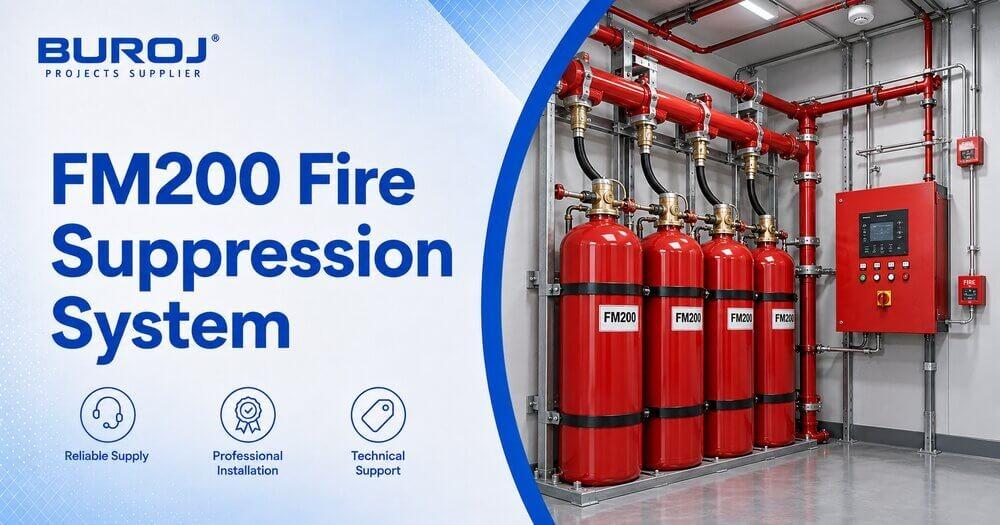
An FM 200 system is a clean-agent fire suppression system that uses HFC-227ea to suppress fires in enclosed spaces without leaving water or powder residue. It is commonly selected for server rooms, electrical rooms and other areas with sensitive equipment. The performance of an FM 200 system depends on correct design, installation and commissioning, not on the agent alone. This guide covers its components, design, applications, Saudi requirements and cost. El Buroj supports Saudi projects with FM-200 supply, installation and commissioning.
What Is an FM 200 System and How Does It Work?
An FM 200 system is a fixed fire suppression system that protects a defined enclosed volume by discharging the gaseous clean agent HFC-227ea at a designed concentration.
FM-200 is the commonly used name for HFC-227ea, its chemical designation. The agent is a gas, not a powder.
It is stored in cylinders and released through a piping and nozzle network.
An FM 200 system suppresses fire mainly by absorbing heat and interfering with the combustion process, not by simply displacing oxygen.
The system is designed around the protected volume and required concentration.
What Are the Main Components of an FM200 Fire Suppression System?
An FM200 fire suppression system combines storage, distribution, detection and control components, and the approved design fixes their quantity.
- Storage cylinder: holds the FM-200 agent under pressure.
- Cylinder valve and actuator: release the agent on a control panel signal.
- Discharge piping and nozzles: carry and distribute the agent through the enclosure.
- Detection devices and control panel: detect a fire and run the release sequence.
- Manual release and abort switch, where applicable: allow discharge or pause release.
- Audible and visual warning devices: alert occupants before discharge.
- Pressure monitoring: helps monitor cylinder pressure and system readiness where provided.
- Control interfaces: connect to HVAC, power shutdown and building alarms.
FM-200 System Design: What Must Engineers Calculate?
FM 200 system design determines the agent quantity, cylinder arrangement, piping and nozzle configuration needed to protect one specific enclosure.
For project teams, the key point is that FM 200 system sizing starts with the protected enclosure and design criteria, not with selecting a cylinder size first. Engineers define:
- Protected room volume and hazard classification
- Design concentration and minimum design temperature
- Agent quantity, cylinder size and quantity
- Pipe network, nozzles and discharge time
- Pressure relief, room integrity, detection logic and shutdown interfaces
FM200 fire suppression system design is not determined by floor area or cylinder count alone. Piping and flow calculations confirm that the agent reaches every nozzle at the right rate and within the specified discharge time, and discharge raises room pressure, so pressure relief must be checked.
El Buroj approaches FM-200 supply and installation around the approved design, BOQ and required interfaces.
How Does an FM200 Fire Suppression System Activate?
An FM200 fire suppression system activates through a controlled sequence: detection, control panel processing, warning, release and agent discharge:
- Detectors sense smoke or heat, using cross-zoned logic where the design requires it.
- The control panel processes the detector signals according to the programmed release logic.
- Where required by the design, a pre-discharge alarm gives occupants time to evacuate before agent release.
- When the release conditions are met, the control system activates the cylinder release mechanism and the agent discharges through the nozzles.
The exact sequence depends on the approved design. Integration with fire alarm systems requires compatible detection and panel equipment.
FM-200 Fire Suppression System for Server Rooms and Data Centers
An FM-200 fire suppression system for server room protection is used because the agent suppresses fire without water or powder that could damage electronics.
- Rapid suppression helps limit damage to critical equipment.
- The enclosure must suit a total-flooding application, with adequate room integrity and pressure relief.
- Detection, alarm and HVAC interfaces may form part of the design.
An FM 200 system can be suitable for many server rooms and data centers. Final agent selection depends on the hazard, enclosure, occupancy and specification.
Where Is the FM200 System Used?
The FM200 system is used in enclosed areas where water or powder residue could damage valuable equipment.
- Server rooms and data centers
- UPS rooms, electrical rooms and control rooms
- Telecommunications and critical electronic equipment rooms
Suitability of an FM 200 system depends on the hazard, occupancy and enclosure. FM-200 is not intended for every fire class.
When Should You Choose an FM200 Fire Suppression System?
An FM200 fire suppression system should be considered when sensitive equipment sits inside a reasonably sealed space.
- Water damage is unacceptable, rapid suppression is required, or the specification calls for a clean agent.
- The FM 200 system can be designed to meet applicable safety and regulatory requirements.
- The protected space can maintain the required agent concentration for the design period.
Another approach may suit large open areas or spaces that cannot be sealed.
FM200 vs Other Fire Suppression Systems
FM200 differs mainly in agent type, residue and enclosure requirements.
Water sprinkler systems
- Uses: water.
- Fits: general building protection. See fire sprinkler systems.
- Consideration: water can damage sensitive electronics.
CO2 systems
- Uses: carbon dioxide.
- Fits: specific industrial hazards with safeguards.
- Consideration: CO2 can create an oxygen-deficient atmosphere and presents significant personnel hazards in occupied spaces.
Dry chemical systems
- Uses: powder agent.
- Fits: applications where dry chemical suppression is appropriate and post-discharge cleanup is acceptable.
- Consideration: powder can damage sensitive equipment.
Inert gas systems
- Uses: gases that reduce oxygen concentration.
- Fits: enclosed areas needing a clean agent.
- Consideration: inert gases may require more storage space because of their storage and design
- characteristics.
Other clean-agent approaches
- Uses: other residue-free agents.
- Consideration: selection depends on cost, storage space and requirements.
FM200 System Requirements in Saudi Arabia
FM200 system requirements in Saudi Arabia vary by project, occupancy, authority requirements and approved fire protection specifications.
- Authority having jurisdiction, Saudi Civil Defense and consultant requirements
- Project specifications
- Applicable NFPA requirements, including NFPA 2001 for clean-agent systems where applicable
- Approved drawings, submittals and commissioning documentation
NFPA 2001 sets technical requirements for clean-agent systems, but it does not replace Saudi authority or project requirements.
Contractors and consultants should confirm the FM 200 system specification, approved equipment and design criteria before procurement. El Buroj works from the approved requirements; authority approval remains a project responsibility.
FM200 Fire Suppression System Installation, Supply & Commissioning by El Buroj
El Buroj supports Saudi projects with FM200 fire suppression system supply, design coordination, installation, testing, commissioning and project documentation, coordinating with contractors and consultants as the project requires.
FM-200 protection sits within the wider fire fighting equipment package. The scope follows the project's BOQ, specifications and approved design.
Planning an FM-200 project in Saudi Arabia? Send your BOQ or project requirements to El Buroj for a project-based quotation covering supply, installation and commissioning.
What Determines FM200 System Cost in Saudi Arabia?
FM200 system cost in Saudi Arabia can start at around 23,600 and exceed 32,000 for complete cylinder and basic system setups, depending on capacity, certification and equipment specifications.
Larger or more complex projects can cost more because they need additional cylinders, piping, nozzles, detection, controls and installation.
Main cost factors:
- Protected room volume: larger spaces need more agents and larger or additional cylinders.
- Piping and nozzles: longer or more complex networks increase material and installation needs.
- Detection, controls, installation and commissioning: detectors, panels, labour, testing and documentation affect quotations.
- Specifications, certification and zones: required approvals and multi-zone controls change the cost.
The range is an indicative reference for complete cylinder and basic system setups, not a fixed price for every FM 200 system. FM200 systems are designed from protected volume and system calculations, so a per-square-meter price would be misleading. Prices change with market conditions and availability. A final quotation requires the protected volume, approved design, BOQ and installation scope.
Common FM200 System Design and Installation Mistakes
Most problems in an FM 200 system come from design and coordination errors, not the agent.
- Sizing by floor area only: can leave the concentration wrong.
- Incorrect cylinder quantity or nozzle positioning: causes insufficient agent or uneven distribution.
- Inadequate room integrity or pressure relief: lets agent leak or risks structural stress.
- Poor HVAC coordination or missing shutdown interfaces: lets air movement dilute the agent or leaves power running.
- Incorrect detection logic: risks false or delayed release.
- Incomplete testing and commissioning: hides faults until a real event.
- Installing without checking the approved design: creates mismatches with the engineered system.
FAQs About FM 200 Systems
What is the FM-200 suppression system?
A fixed clean-agent system that protects enclosed spaces by discharging HFC-227ea gas at a designed concentration.
Is FM-200 a gas or powder?
FM-200 is a gaseous clean agent, not a powder.
What are the disadvantages of FM-200?
Cost, the need for a sealed enclosure, environmental and regulatory considerations, and the need for engineered design.
What is the difference between FM-200 and CO2?
FM-200 is a clean agent used in applicable occupied spaces. CO2 creates an oxygen-deficient atmosphere hazardous to people.
What is another name for FM-200?
FM-200 is commonly identified by its chemical name, HFC-227ea.
Is FM-200 gas safe for humans?
FM-200 systems can be designed for use in applicable occupied spaces, but safety depends on concentration, exposure limits, warning, evacuation procedures and applicable requirements.