
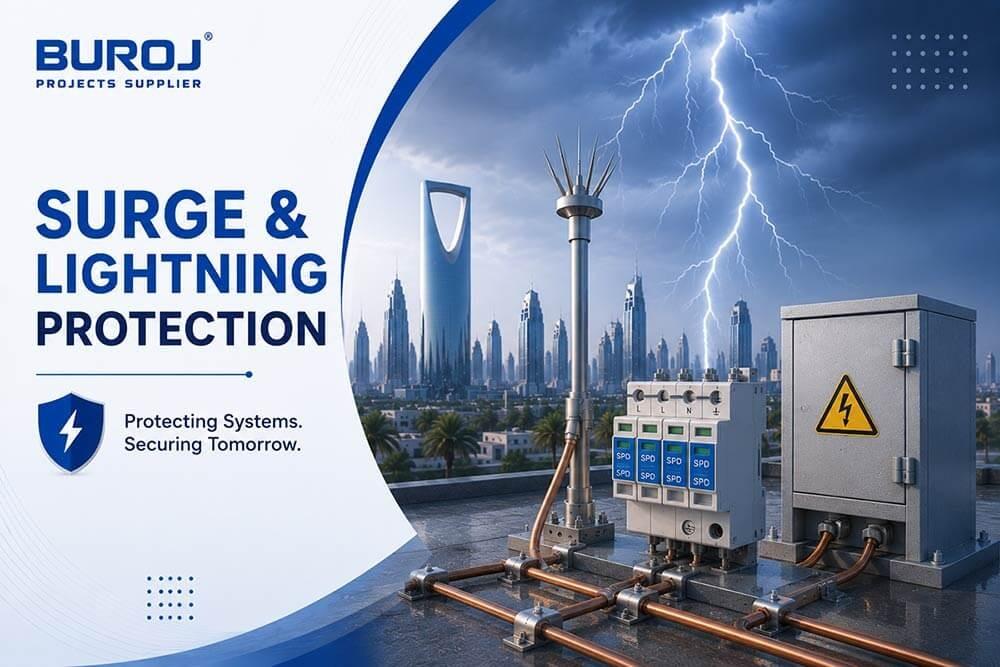
When it comes to protecting buildings and electrical infrastructure from transient overvoltages, understanding the types of surge arresters is essential for every engineer, contractor, and facility manager. Surge arresters serve as the first line of defense against lightning strikes and voltage spikes, preventing costly damage to sensitive equipment. Whether you are planning a new installation or upgrading an existing lightning rod system, choosing the right arrester type is critical. In this guide, El Buroj walks you through everything you need to know.
What Are the Main Types of Surge Arresters?
Surge arresters are classified based on their construction, voltage class, and the application they are designed for. The main types of surge arresters used across residential, commercial, and industrial buildings include the following:
1. Station Class Surge Arresters
Designed for high-voltage substations and transmission lines. These offer the highest energy-handling capacity and are built for long-term outdoor exposure in extreme conditions.
2. Intermediate Class Surge Arresters
Used in distribution systems at medium voltage levels, typically between 3 kV and 36 kV. They balance cost and performance for distribution networks.
3. Distribution Class Surge Arresters
The most widely used type for protecting distribution lines, transformers, and equipment at voltages from 1 kV to 36 kV.
4. Secondary Class Surge Arresters (SPD)
Also called Surge Protection Devices (SPDs), these are installed at the low-voltage (LV) end of electrical systems, protecting building panels, sockets, and appliances.
5. Gapless Metal Oxide Varistor (MOV) Arresters
Modern, gap-free design using zinc oxide elements. They react faster and are more thermally stable than traditional gap-type arresters.
6. Expulsion-Type (Gap) Arresters
An older technology that uses a spark gap to divert the surge. They are still used in rural distribution networks due to their low cost.
7. Polymer-Housed Surge Arresters
Features a silicone rubber housing instead of porcelain, offering superior mechanical strength and hydrophobicity, ideal for coastal and high-pollution zones like many areas of Saudi Arabia.
Selecting the correct type depends on the voltage class, installation environment, and level of protection required. Consult the El Buroj electrical products section for the full range of available products.
Talk to our experts and get complete pricing for surge & lightning protection solutions in minutes.
Get Instant Pricing via WhatsApp or Call: 920031298
Surge Arrester vs. Lightning Arrester: What is the Difference?
A common source of confusion is the distinction between a surge arrester and a lightning arrester for building applications. A surge arrester is a broad category covering all devices that limit transient overvoltages, regardless of origin: lightning, switching operations, or utility faults. A lightning arrester, by contrast, refers specifically to devices installed on or near a structure to intercept and redirect the direct energy of a lightning strike safely to earth, protecting both the building fabric and the internal electrical systems.
In a complete lightning rod system, the air termination rod captures the lightning strike, the down conductor routes the current safely to the ground electrode, and the surge arrester at the electrical panel handles the residual transient that enters through the supply cables. Both components must be correctly specified and coordinated to ensure full protection across the entire building.
How Surge Arresters Work in a Lightning Protection System
Regardless of the types of surge arresters selected, they all operate on the same fundamental principle. Under normal operating voltage, the device presents very high impedance and allows current to pass undisturbed. The moment a voltage transient exceeds the arrester's clamping voltage, it switches to low impedance, diverting the excess energy to the ground conductor and protecting downstream equipment.
According to IEC 62305 and SASO standards, surge arresters are installed at three coordinated protection levels in every building's electrical system:
Type 1 (Class I) SPDs
Installed at the main distribution board directly after the utility meter. These are the most critical types of surge arresters in terms of energy-handling capacity and are mandatory in buildings that have an external lightning protection system.
Type 2 (Class II) SPDs
Installed at sub-distribution panels throughout the building. They suppress residual surges that pass through the Type 1 device.
Type 3 (Class III) SPDs
Fine-protection devices are installed close to sensitive equipment such as servers, PLCs, medical devices, and CCTV systems.
Proper coordination between all three types of surge arrester levels is essential to ensure there are no gaps in the protection chain.
What Are the Types of Lightning Arresters for Buildings?
When engineers specify protection systems for a building project, they select from the following categories based on the structure's risk assessment under IEC 62305-2 or NFPA 780. Each represents a distinct type of surge arrester approach suited to different building sizes and risk levels:
1. ESE (Early Streamer Emission) Lightning Arresters
ESE arresters are active air terminals that generate an upward leader streamer earlier than a conventional Franklin rod, significantly extending the radius of protection. They are the preferred air terminal solution for large commercial buildings, industrial plants, and telecom towers in Saudi Arabia, where a single active terminal can replace multiple passive rods.
2. Franklin Rod (Conventional) Lightning Arresters
The classic pointed copper or stainless-steel rod is connected to earth via a down conductor. Simple, reliable, and cost-effective for residential villas and low-rise buildings when positioned correctly at roof ridges, corners, and high points.
3. Faraday Cage (Meshed Conductor) Systems
A grid of conductors laid across the entire roof surface, bonded at multiple earth electrode points. The recommended approach for large flat-roof structures such as warehouses, hospitals, and data centers, providing uniform protection across the full roof area.
4. Surge Protective Devices (SPDs) for Electrical Panels
Installed inside the main electrical distribution board, SPDs are the indoor component that protects all downstream wiring and appliances. They are required by the Saudi building code for any structure that has an external lightning protection system.
Key Components of a Professional Lightning Protection System
A fully compliant protection system integrates multiple components. All of the following must be specified alongside the correct types of surge arrester for each protection level:
- Air Termination System: ESE terminals, Franklin rods, or meshed conductors positioned at the highest points of the structure to intercept lightning strikes.
- Down Conductors: Bare copper or aluminum cables that route lightning current from the air terminal to the earth electrode system. El Buroj stocks bare copper cables and yellow/green earthing cables suited for down-conductor applications.
- Earth Termination System: Ground rods, ring conductors, or earth plates buried to safely dissipate lightning energy into the soil.
- Bonding and Equipotential Links: Conductors that connect all metallic structures (pipes, railings, and HVAC frames) to prevent dangerous side-flash inside the building.
- Surge Protection Devices at Panel Level: Types 1, 2, and 3 SPDs are coordinated across the distribution system to protect against conducted transients entering through power and data lines.
For the complete cabling range, visit El Buroj cables and special cables.
Top Surge Protection Brands Available in Saudi Arabia
When evaluating lightning arrester brands for Saudi projects, the key criteria are energy-handling ratings, SASO compliance, and local technical support availability. The following are the most trusted names in the market:
- Schneider Electric:
A globally recognised leader in energy management and automation, Schneider Electric offers a comprehensive range of surge protection devices covering Type 1, 2, and 3 SPDs. Their Acti9, Resi9, and Compact NS product lines are widely specified across commercial, industrial, and infrastructure projects throughout Saudi Arabia, with full SASO compliance documentation and strong in-country technical support.
- Legrand:
French electrical infrastructure specialist Legrand brings a deep catalog of SPDs engineered for both residential and commercial applications. Their surge protection range is valued by Saudi contractors for its reliable clamping performance, ease of DIN-rail installation, and compatibility with the full Legrand distribution board ecosystem, making it a practical choice from villa panels through to large commercial fit-outs.
- ABB & Eaton:
ABB and Eaton each bring proven industrial-grade surge protection solutions to the Saudi market. ABB’s OVR series and Eaton’s SPDN/SPDB product families are engineered for demanding environments, offering high discharge current ratings suited to Type 1 installations at main distribution boards in factories, utilities, and critical facilities. Both brands carry the certifications required for SASO-compliant specification on government and large private-sector projects.
- Alfanar
A leading Saudi electrical manufacturer with deep roots across the GCC, Alfanar produces a range of surge protective devices specifically engineered for the regional climate, including the high-humidity coastal zones and extreme temperatures common across Saudi Arabia. Alfanar’s local manufacturing capability, Saudi-standard compliance, and established distribution network make their SPD range a cost-competitive and logistically straightforward choice for contractors working on domestic projects at scale.
At El Buroj, we work with certified suppliers and can match the right brand and model to your project budget and specification. Contact us on WhatsApp for current availability and pricing | Call: 920031298.
How to Choose the Right Lightning Arrester for Your Building?
Choosing the correct types of surge arrester for a building project requires a structured engineering process. Skipping steps can result in under-protection or over-specification. Here is the recommended approach:
- Step 1: Risk Assessment: Calculate the building's lightning risk level using IEC 62305-2. The result defines which class of types of surge arresters is mandatory for the project.
- Step 2: Determine the System Voltage: Confirm whether protection is needed at the high-voltage (HV), medium-voltage (MV), or low-voltage (LV) level of the electrical system.
- Step 3: Define the Protection Level: Select the appropriate Lightning Protection Level (LPL I–IV) and match it to the corresponding types of surge arrester energy classes.
- Step 4: Choose the Housing: For outdoor or coastal Saudi installations, polymer-housed surge arresters are preferred over porcelain due to superior resistance to humidity, salt, and dust.
- Step 5: Verify SASO Compliance: All selected surge arrester products must carry valid SASO certification and relevant IEC test documentation.
- Step 6: Coordinate Protection Levels: Ensure proper voltage protection level (Up) coordination between Type 1, 2, and 3 SPDs to avoid protection gaps or back-to-back surge damage.
The technical team at El Buroj can review your project drawings and prepare a full bill of materials covering all required types of surge arrester and associated cabling.
Explore the full electrical products section or contact us directly for a personalized quotation, and Protect Your Building Today
WhatsApp: +966 53 496 4817 | Call: 920031298
Why Choose El Buroj for Surge & Lightning Protection
El Buroj is a leading electrical materials supplier in Saudi Arabia, serving contractors, engineering consultants, and facilities managers. When it comes to sourcing the right types of surge arresters and supporting components, here is why thousands of professionals trust us:
- Complete Product Range: All types of surge arresters from Type 1 SPDs to distribution-class arresters, alongside bare copper cables, earthing cables, special cables, and lighting products.
- Bulk Supply Capability: Large-volume orders for contractors and government projects fulfilled with guaranteed lead times.
- Competitive Pricing: Direct manufacturer sourcing enables market-leading prices. Request a bulk quotation via WhatsApp for the best rates on all surge protection products.
- Technical Support: Product selection guidance, SASO compliance documentation, and technical datasheets for every product we supply.
- Fast Local Delivery: In-country warehouse stock ensures rapid fulfillment for urgent project requirements across Saudi Arabia.
- SASO-Compliant Products: All types of surge arresters and electrical products we supply meet Saudi regulatory requirements, minimizing compliance risk on-site.
Talk to our experts and get complete pricing for surge & lightning protection solutions in minutes.
Get Instant Pricing via WhatsApp or Call: 920031298
FAQs About Types of Surge Arrester
What are the main types of surge arresters used in buildings?
The main types of surge arresters for buildings are Type 1, Type 2, and Type 3 SPDs, coordinated from the main panel to the equipment level. Each type handles a different surge energy level and location in the system.
What is the difference between a Type 1 and a Type 2 surge arrester?
A Type 1 SPD handles large lightning-origin surges at the main distribution board. A Type 2 SPD suppresses residual transients at sub-panels. Both must be coordinated for comprehensive building protection.
Are surge arresters required by Saudi building codes?
Yes. SASO standards and the Saudi Electricity Authority require appropriate surge protection in buildings with lightning protection systems and structures above certain risk classifications.
How long does a surge arrester last?
Quality MOV-based surge arresters typically last 10 to 20 years under normal conditions. After a major surge event, the device should be inspected and replaced if the built-in fault indicator is triggered.
Which types of surge arresters are best for coastal areas in Saudi Arabia?
Polymer-housed MOV surge arresters are the best choice for coastal and high-humidity areas. Their silicone rubber housing provides superior resistance to salt spray, moisture, and pollution compared to porcelain housings.
Does El Buroj supply surge arresters for large commercial projects?
Yes. El Buroj supplies a full range of surge protection devices and lightning protection components for residential, commercial, and industrial projects across Saudi Arabia, with bulk ordering options.
How do I get a quotation from El Buroj?
You can request a bulk quotation instantly via WhatsApp at +966534964817 or by calling 920031298. Our team responds with pricing and availability within the same business day.