
Saudi Arabia's climate, intense summer thunderstorms, coastal humidity, and expansive industrial infrastructure makes a reliable lightning protection system a critical safety requirement, not an optional upgrade. Direct lightning strikes cause structural fires, equipment destruction, and fatal electrical hazards. For MEP contractors, engineers, and procurement teams, understanding lightning protection system design, installation, and compliance with IEC 62305 and Saudi Building Code requirements is essential from project specification through commissioning.
What Is a Lightning Protection System?
A lightning protection system (LPS) is an engineered network of conductors, air terminals, and earthing electrodes designed to intercept lightning strikes, safely conduct the discharge current to ground, and prevent it from passing through the building structure or electrical infrastructure. It does not prevent lightning from striking, it controls where it strikes and ensures the energy dissipates harmlessly into the earth.
A complete LPS integrates two functions: external protection (air terminals, down conductors, and earth termination network) and internal protection (equipotential bonding, surge protection devices, and shielding). Both must be designed and installed together for the system to be compliant and effective.
From Engineering Design to Site Installation – El Buroj is your trusted partner for Lightning Protection & Earthing Systems.
Request your quote now
WhatsApp: +966 53 496 4817 | Call: 920031298
What Are the Main Components of a Lightning Protection System?
- Air Terminals (Lightning Rods)
The strike termination point. Air terminals intercept the lightning discharge before it contacts the building structure. Designs include conventional Franklin rods, early streamer emission (ESE) terminals, and meshed cage (Faraday cage) configurations, selected depending on building geometry and IEC 62305 protection level requirements.
- Down Conductors
Copper or aluminium conductors that route the captured lightning current from air terminals down the building facade to the earth termination network. IEC 62305-3 specifies minimum conductor cross-sections (50 mm² copper or 70 mm² aluminium) and maximum spacing between down conductor runs based on protection level. Bare copper conductors rated for lightning current duty are the standard specification in Saudi commercial and industrial projects.
- Earth Termination Network
The earth termination network dissipates the lightning current into the ground. This is where the earthing and lightning protection system, integrating a low-resistance, low-impedance earth electrode network, is not optional. IEC 62305-3 targets ≤10 Ω for the LPS earth termination, with lower values recommended for high-value or sensitive facilities. El Buroj's complete earthing and grounding range covers earth rods, bonding accessories, and conductor materials for this critical interface.
- Bonding Components
All metallic services entering the structure, water pipes, gas lines, electrical cable armour, HVAC ductwork, and structural steel must be bonded to the LPS at the point of entry. This eliminates dangerous potential differences between metallic elements during a strike. Earthing accessories, including bonding clamps, earth busbars, and connection hardware, form this layer of the system.
- Surge Protection Devices (SPDs)
SPDs protect electrical and electronic systems from indirect lightning effects, conducted and induced surges entering through power, data, and signal lines. SPDs are installed at main distribution boards and sub-boards, coordinated with the circuit breakers and panel infrastructure to provide a full overvoltage protection chain.
Lightning Protection System Design: Standard Requirements
Lightning protection system design in Saudi Arabia must comply with:
- IEC 62305 (Parts 1-4): The primary international standard covering risk assessment, system design, physical components, and electrical/electronic system protection.
- NFPA 780: Referenced on American-spec projects and petrochemical facilities in KSA.
- Saudi Building Code (SBC 401): Mandates LPS on structures above defined height thresholds and on high-risk occupancy buildings.
Risk assessment is the starting point of every compliant design. IEC 62305-2 requires evaluation of:
- Strike frequency: Based on the building's location, dimensions, and the local ground flash density (GFD) for the project region.
- Building classification: Hospitals, data centres, petrochemical plants, and public assemblies carry a higher risk weighting and require LPS Protection Level I or II.
- Consequence of failure: Installations with flammable materials, uninterruptible processes, or high-occupancy require more stringent protection levels.
The output of the risk assessment determines the Protection Level (I-IV), which drives rolling sphere radius, conductor spacing, mesh dimensions, and earth resistance targets across the full lightning protection system design.
Lightning Protection System Installation Steps
Correct lightning protection system installation follows a defined sequence deviating from it creates compliance failures that are expensive to correct after structure completion.
- Risk assessment and protection level determination: Complete before any structural work. Protection level drives all subsequent design decisions.
- Air terminal layout: Position air terminals per the rolling sphere method or protective angle method (IEC 62305-3). Roof-mounted equipment, plant, and edges must fall within the defined protection zone.
- Down conductor routing: Plan conductor routes down the external facade or within the structure. Minimum separation distances from internal electrical systems must be maintained to avoid dangerous side-flashing. Conductors terminate at test clamps at ground level for periodic resistance measurement.
- Earth termination installation: Install earth rods and ring electrodes. In Saudi Arabia's high-resistivity sandy soils, ring earth electrodes around the building perimeter combined with vertical rods are commonly required to achieve ≤10 Ω. Chemical earthing compound backfill is standard where soil resistivity exceeds 300 Ω·m.
- Equipotential bonding: Bond all metallic services at entry points. Install the bonding bar at the main entry level. Use yellow/green PE cables for identified bonding conductors where IEC 60446 colour coding applies.
- SPD installation: Coordinate surge protection device installation with electrical panel construction. SPD Class I at the main board; Class II/III at sub-boards and equipment level.
- Continuity and resistance testing: Test all conductor continuity, down conductor resistance, and earth termination resistance. Document results for project authority and SEC inspection.
- Commissioning and handover: Issue test certificates, as-built drawings, and IEC 62305 compliance declaration.
Need lightning protection system design support or material supply for your project?
WhatsApp: +966 53 496 4817 | Call: 920031298
Where Are Lightning Protection Systems Used?
- Lightning Protection System for Buildings
Any structure above 20 m in height in Saudi Arabia falls within the mandatory LPS scope under SBC 401. Commercial towers, hotels, hospitals, schools, mosques, and government buildings all require a designed and certified lightning protection system. High-rise facades with aluminium cladding require special down-conductor integration to avoid the cladding becoming an unplanned current path.
- Lightning Protection System for Home
A lightning protection system for homes In particular, standalone villas, rural properties, and properties with elevated rooftop plants are strongly recommended in KSA even where not mandated. Detached villas with swimming pools, elevated HVAC equipment, or solar PV installations face elevated strike risk. A residential LPS typically involves a single ESE terminal or conventional rod, two down conductors, and a ring earth electrode simpler than a commercial design but following the same IEC 62305 principles.
- Industrial and Petrochemical Facilities
Refineries, tank farms, substations, and logistics hubs in the Eastern Province and Jubail Industrial City operate under the strictest LPS requirements. These facilities specify IEC 62305 Protection Level I, extensive earth grids, isolated down conductors, and full SPD coordination across process control and SCADA systems.
- Telecommunications and Data Infrastructure
Tower sites, data centres, and remote monitoring installations require LPS integrated with EMC shielding and signal SPDs. The earthing and lightning protection system must achieve very low impedance values (often ≤1 Ω) to protect sensitive electronics from conducted surge energy.
Lightning Protection System Cost in Saudi Arabia
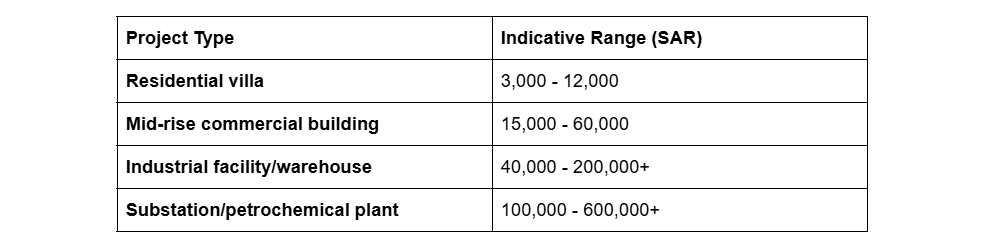
Lightning protection system price varies significantly based on project scope and site conditions. Indicative ranges for KSA projects:
Project Type
Indicative Range (SAR)
Residential villa
3,000 - 12,000
Mid-rise commercial building
15,000 - 60,000
Industrial facility / warehouse
40,000 - 200,000+
Substation / petrochemical plant
100,000 - 600,000+
Key cost drivers:
- Building size and height: More air terminals, longer down conductor runs, and larger earth termination networks increase material and labour costs proportionally.
- Protection level: Level I installations require tighter air terminal spacing, heavier conductors, and lower earth resistance, all cost-additive versus Level III or IV.
- Soil resistivity: High-resistivity desert soils common across Central and Northern KSA require deeper rods, wider ring electrodes, or chemical compound treatment. This is the most variable cost factor on Saudi projects.
- SPD scope: Full SPD coordination across main boards, sub-boards, and equipment level adds 2040% to overall system cost, but is required for IEC 62305 Part 4 compliance.
- Design and documentation: IEC 62305 risk assessment, design drawings, and test certification are billable deliverables, typically 1020% of the material and installation cost.
For accurate project pricing based on your BOQ or building specifications, contact El Buroj directly.
Why Choose El Buroj for Your Lightning Protection Needs?
El Buroj is a full MEP electrical supplier serving contractors, engineers, and procurement teams across Saudi Arabia. Beyond supplying lightning protection materials, El Buroj delivers complete lightning protection and earthing solutions, including design support, system integration, installation, testing, and project execution for residential, commercial, and industrial facilities across the Kingdom.
For lightning protection projects, El Buroj offers:
- Complete material range: Down conductors in bare copper, earthing electrodes and accessories, bonding hardware, PE cables, and panel infrastructure all IEC-certified and SEC-compliant, sourced from a single supplier.
- Earthing and lightning protection integration: El Buroj supplies and executes fully coordinated LPS and earthing systems to ensure compliant earth termination network design, safe dissipation of lightning current, and long-term system reliability.
- Design and technical engineering support: Assistance with protection level selection, conductor sizing, earth resistance targets, risk assessment coordination, compliance documentation, and project-specific system design.
- Turnkey execution capability: From material supply and site implementation to testing and commissioning, El Buroj delivers complete lightning protection solutions tailored to project requirements.
- Bulk supply capability: BOQ fulfilment for single villas through to full industrial LPS packages. Volume pricing available for contractors and procurement teams.
- Nationwide delivery and project coverage: Riyadh, Jeddah, Dammam, Al Khobar, Mecca, Medina, and project sites across KSA with logistics scaled for full MEP packages.
Request a quote or contact the El Buroj technical team for complete lightning protection solutions, installation, and project-specific support across Saudi Arabia.
WhatsApp: +966 53 496 4817 | Call: 920031298
FAQs About Lightning Protection Systems
What is a lightning protection system?
An engineered network of air terminals, down conductors, and earth electrodes that intercepts lightning strikes and safely conducts the discharge current to ground, preventing structural damage, fire, and electrical system failure.
What are the types of lightning protection systems?
The main lightning protection system types are: conventional Franklin rod systems, Early Streamer Emission (ESE) systems, and Faraday cage (mesh) systems. Selection is based on IEC 62305 protection level requirements and building geometry.
What is the difference between earthing and lightning protection?
Earthing protects against power system faults and touch voltage. Lightning protection intercepts and dissipates direct strike energy. Both share the earth termination network; the earthing and lightning protection system must be integrated and designed together for full IEC 62305 compliance.
Is a lightning protection system required in Saudi Arabia?
Yes, for buildings above defined height thresholds and high-risk occupancy types under SBC 401. IEC 62305 compliance is required on all SEC-regulated and internationally specified projects.
What is the lightning protection system price in Saudi Arabia?
Residential systems start from 3,000-12,000. Commercial buildings range 15,000-60,000+. Industrial and petrochemical facilities can exceed 200,000 depending on protection level, soil conditions, and SPD scope.
How long does lightning protection system installation take?
Residential installations: 1-3 days. Commercial buildings: 1-3 weeks depending on height and protection level. Industrial facilities with full earthing grids and SPD coordination: 4-12 weeks. Testing and documentation add time at each scale.