
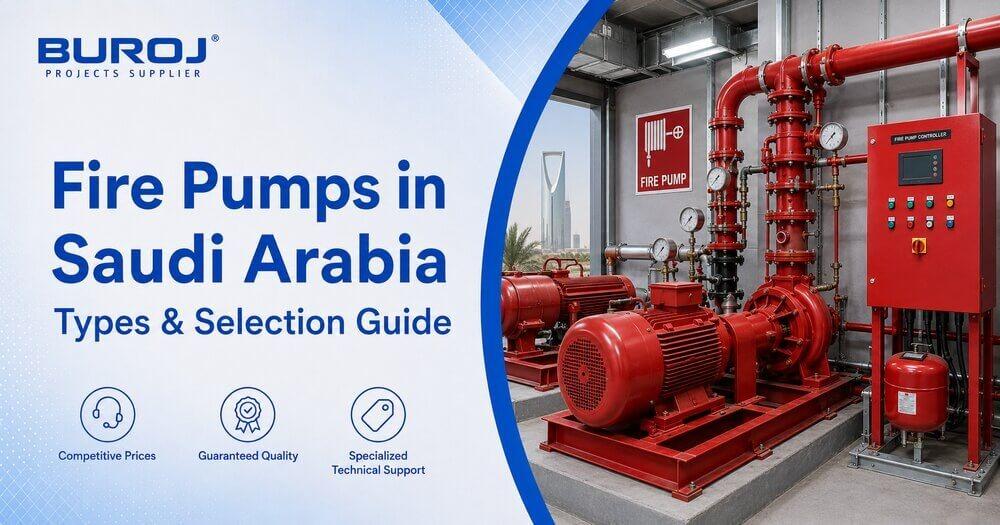
Fire pumps are mechanical devices designed to provide the flow and pressure a building's fire protection system needs when the available water supply cannot meet demand on its own. In Saudi Arabia, fire pumps support sprinklers, hydrants, hose reels, and standpipes across commercial, industrial, and residential projects. Choosing the right fire pump depends on flow rate, pressure, power source, and applicable standards such as NFPA 20. This guide covers the main types, components, costs, and selection factors for fire pumps used in Saudi projects.
What Are Fire Pumps?
Fire pumps are dedicated mechanical devices that supply the pressure and flow a fire protection system needs during a fire, sitting between the water source and the fire protection system. Fire pumps are typically started automatically when the fire protection system experiences a pressure drop requiring the main pump to operate, according to the system's control arrangement.
Municipal water pressure is often adequate for low-rise buildings but insufficient for taller structures or high hydraulic demand. A fire pump differs from an ordinary water pump in design and regulation, it is engineered, tested, and listed for fire protection duty, with performance curves, controllers, and driver arrangements meeting recognized standards.
From a system-design perspective, a pump should never be evaluated as isolated equipment. It works as part of a complete system, water source, suction conditions, piping, controller, valves, and required flow and pressure all considered together.
Types of Fire Pumps
Fire pumps are classified by driver and by pump construction. A jockey pump is a separate pressure-maintenance pump, not another main pump configuration.
- Electric fire pump: Reliable electrical supply; simpler operation.
- Diesel fire pump: Independent/backup power requirement; engine and fuel infrastructure.
- Horizontal split-case: Medium to large flow; maintenance accessibility.
- Vertical turbine: Low-level/underground water source; vertical installation.
- Vertical in-line: Limited floor space; compact arrangement.
- End-suction: Smaller applications; suitable for lower-flow applications when system design permits.
- Jockey pump: Standby pressure maintenance; prevents unnecessary main pump operation.
Expert Insight: Pump configuration should follow the water source, required flow and pressure, and installation space, no single configuration is universally superior. El Buroj's guide on fire pump supplier in Saudi Arabia covers the available configurations in more depth.
Fire Pumps Prices: What Affects the Cost?
There is no single standard price for fire pumps, total cost depends on required flow, pressure, pump type, driver, and project conditions. A fire pump quotation should include the main pump, driver, controller, jockey pump, valves, gauges, testing arrangement, installation, commissioning, documentation, and certification.
When reviewing fire pump quotations, one of the most important considerations is to compare the complete fire pump package, not the pump unit price alone, controllers, valves, testing, installation, and commissioning can materially affect final cost. For a project-specific quotation, WhatsApp or call 920031298.

Fire Pump System Components
A complete fire pump arrangement involves more than the pump:
- Main fire pump, delivers required flow and pressure
- Driver, electric motor or diesel engine
- Controller, starts, stops, and monitors operation
- Jockey pump, maintains standby pressure between runs
- Suction/discharge piping and isolation valves, connect and isolate the pump; understanding the role of different valves in piping systems can also help when reviewing the complete arrangement.
- Check valve, prevents backflow into the water source
- Pressure gauges/sensing components, monitor pressure, trigger start
- Flow measurement/test header, verifies performance against the curve
- Fuel tank, supplies diesel fire pumps with fuel
In practice, component compatibility can affect system reliability as much as pump selection. A correctly selected pump can still perform poorly if suction conditions are unsuitable, piping is misconfigured, or the controller and testing provisions are inadequate.
Diesel Fire Pump vs Electric Fire Pump
Neither driver is universally better; the choice depends on the building, available power, and fire protection design.
Power source:
- Electric Fire Pump: Electrical supply
- Diesel Fire Pump: Diesel engine
Backup:
- Electric Fire Pump: Depends on a reliable electrical supply
- Diesel Fire Pump: Independent of normal electrical supply
Maintenance:
- Electric Fire Pump: Generally simpler
- Diesel Fire Pump: More maintenance-intensive
Noise:
- Electric Fire Pump: Generally lower
- Diesel Fire Pump: Generally higher
Infrastructure:
- Electric Fire Pump: Electrical capacity
- Diesel Fire Pump: Engine + fuel system
Electric fire pumps use an electric motor; diesel fire pumps use a diesel engine. The right option depends on power reliability and applicable standards, not price alone.
Fire Water Pump Applications
Fire pumps are used wherever a fire protection system needs more pressure or flow than the water source can deliver directly, including systems serving fire sprinklers and hydrants.. Requirements vary by facility, so this table is illustrative, not a fixed rule.
- Commercial buildings: Support sprinkler and hydrant networks.
- Warehouses: Meet hydraulic demand for storage protection.
- High-rise buildings: Overcome elevation and friction losses.
- Industrial facilities: Support higher fire protection water demand.
- Hospitals: Support reliable fire protection systems.
- Data centers: Protect critical infrastructure.
- Large compounds: Support multiple buildings from shared systems.
How to Select the Right Fire Pump
Selection should begin with required flow and pressure, not brand or price:
- Required flow rate and pressure/head at the most demanding point
- Overall hydraulic demand of sprinklers, hydrants, or standpipes
- Building height and resulting friction/elevation losses
- Occupancy and hazard classification
- Available water source and electrical power capacity
- Whether diesel backup or independence is required
- Appropriate pump configuration and applicable standards
- Installation environment and future expansion needs
A fire pump's performance curve shows how flow and pressure/head vary across its operating range. Reviewing the curve, not just nominal capacity, helps verify that the pump meets system demand at the most hydraulically demanding point, not only at a single rated condition.
At El Buroj, this type of evaluation means looking beyond pump capacity alone. Flow, pressure, water source, building characteristics, power availability, and installation conditions all need to be considered before specifying the appropriate configuration.
Fire Pump Standards (NFPA 20)
NFPA 20 sets requirements for the selection and installation of stationary fire pumps and associated equipment, covering pump and driver arrangements, controllers, and suction/discharge provisions, not the complete regulatory framework for operation and maintenance.
NFPA 20 is widely referenced in fire protection engineering, but Saudi regulations, applicable authority requirements, and other relevant standards may also apply, and should be confirmed during engineering and project approval.
Fire Pump Maintenance
Regular inspection, testing, and preventive maintenance ensure fire pumps operate correctly during an emergency. A program typically includes visual inspections, pressure checks, valve checks, and periodic operation tests. Electric fire pump maintenance focuses on motor and controller checks; diesel maintenance adds engine, battery, and fuel system checks.
Testing frequency and procedure depend on the applicable NFPA requirements, manufacturer instructions, and project-specific requirements rather than a single fixed schedule.
A practical maintenance approach should not focus only on whether the pump starts. Performance testing and operating conditions also need review against manufacturer requirements.
Why Choose El Buroj for Fire Pumps in Saudi Arabia
El Buroj supports fire protection projects in Saudi Arabia by helping customers select and procure fire pump systems suited to a building's hydraulic requirements, rather than simply selling an isolated pump, including reviewing project requirements, hydraulic sizing support, specification review, pump and driver configuration, equipment supply, and installation and commissioning coordination.
El Buroj supports projects involving electric, diesel, and jockey pump systems, with configuration selected according to project requirements.
Need help selecting fire pumps for a Saudi project? Contact El Buroj on WhatsApp or call 920031298 to discuss your required flow, pressure, water source, pump configuration, and supporting fire protection components.
Frequently Asked Questions
What is the purpose of a fire pump?
A fire pump supplies the pressure and flow a fire protection system needs when the available supply can't meet demand, keeping sprinklers, hydrants, and standpipes adequately pressurized.
How does a fire pump work?
A pressure drop is detected by the controller, which starts the pump automatically. The pump delivers water at the required flow and pressure until the controller stops it or it's shut down manually.
What is the difference between a fire pump and a jockey pump?
A fire pump supplies the main flow and pressure during a fire; a jockey pump maintains normal standby pressure and compensates for minor losses without starting the main pump unnecessarily.
Is a diesel or electric fire pump better?
Neither is universally better, the choice depends on power reliability, backup needs, and the engineered fire protection design for the building.
How much does a fire pump cost in Saudi Arabia?
Cost depends on required flow, pressure, driver type, and configuration rather than a fixed figure. A realistic estimate reflects the complete system, not the pump unit alone.
How do you choose the right fire pump?
Start with required flow and pressure at the most demanding point, then evaluate water source, building characteristics, power availability, and applicable standards before specifying a configuration.
What does NFPA 20 cover?
NFPA 20 covers the selection and installation of stationary fire pumps and associated equipment, including drivers, controllers, and suction/discharge arrangements, not every local regulatory requirement.
How often should fire pumps be tested?
Fire pump testing frequency depends on the applicable NFPA requirements, manufacturer instructions, and project conditions. Testing should verify both operational readiness and system performance rather than simply confirming that the pump starts.
What size fire pump do I need?
The required fire pump size depends on the system's hydraulic demand, including required flow, pressure, elevation, friction losses, water source, and the most demanding fire protection scenario. Pump size should be determined through an engineered calculation rather than building size alone.
Is a fire fighting pump the same as a fire pump?
Yes. "Fire fighting pump" and "fire pump" refer to the same equipment. Both describe a pump dedicated to supplying flow and pressure to a fire protection system, as distinct from a general-purpose water pump.