
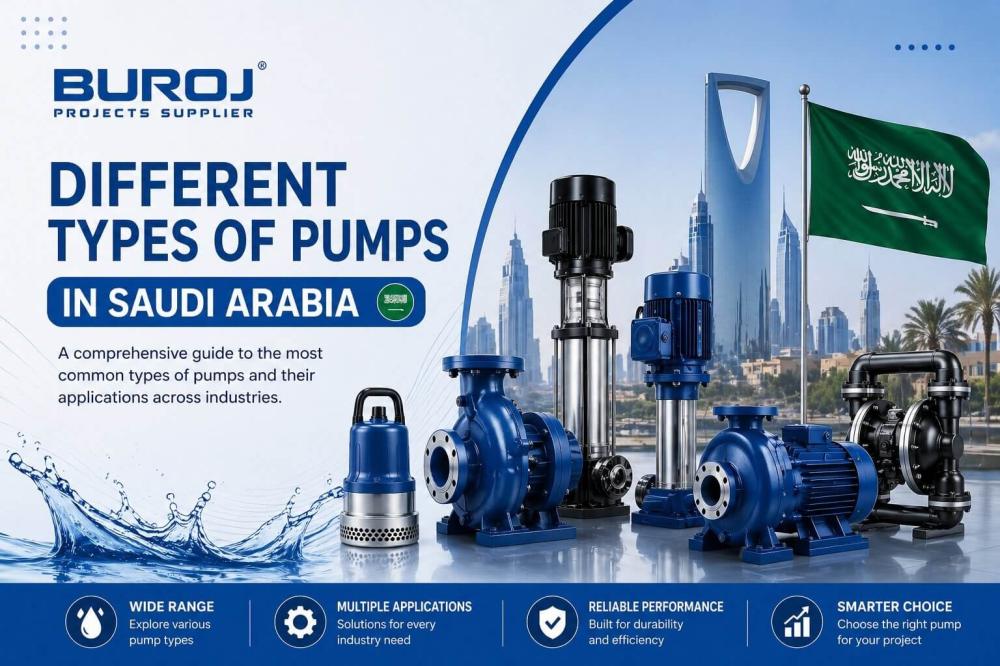
Choosing the right pump is one of the most critical decisions on any construction or MEP project in Saudi Arabia. The different types of pumps available each serve a distinct function. Understanding the types of water pumps is essential for selecting the right system, from pressurising water in high-rise towers to draining groundwater on major construction sites. Selecting the wrong type means inefficiency, equipment failure, and costly rework. This guide covers all major pump types, explains their functions, and gives you a practical selection framework for Saudi projects.
Understanding the Different Types of Pumps in Saudi Arabia
Saudi Arabia's Vision 2030 construction boom has driven enormous demand for fluid management systems across residential, commercial, and industrial sectors. Developments like NEOM, the Red Sea Project, and Diriyah Gate require pump networks spanning water supply, firefighting, HVAC, sewage, and industrial processing.
The Kingdom's extreme heat, high-mineral groundwater, and strict Saudi Civil Defense (SCD) regulations make pump selection more demanding than in milder markets. Understanding which types of pumps suit each application is essential for project success and code compliance.
Explore El Buroj's full MEP materials range at elburoj.com.
Comprehensive Look at Centrifugal Pump Types
Centrifugal pumps are the most widely used pump family globally, accounting for over 70% of all pump installations. They convert motor-driven rotational energy into fluid velocity and pressure via an impeller. The types of centrifugal pumps available cover a broad range of heads, flows, and applications.
End Suction Centrifugal Pumps
Single-stage, compact, and easy-to-maintain end suction pumps are the most common centrifugal pump type in Saudi buildings. Used for water supply, HVAC circulation, and irrigation, they connect directly to PVC plastic pipes or metal pipes, depending on pressure rating.
Split Case Centrifugal Pumps
A horizontally split casing gives maintenance teams access to the impeller without disturbing the pipework. Split case pumps deliver very high flow rates and are the standard choice for fire pump stations and large district water networks. Complement these systems with certified pipe fittings and accessories for leak-free pressure-rated connections.
Multistage Centrifugal Pumps
Multistage pumps build pressure by passing fluid through two or more impellers in series. They are ideal for booster systems, reverse osmosis plants, and high-rise towers exceeding 30 floors, where high head at moderate flow is required. In Saudi Arabia, multistage units are standard in desalination and luxury residential developments.
Among the different types of pumps, centrifugal systems remain the most widely used due to their efficiency and flexibility.
Get Your Pump Delivered Across KSA in 48 Hours – Bulk Prices & Warranty
Whether you need a water pump, submersible pump, or fire pump, El Buroj offers fast delivery. Request your quote and get a reply in 30 minutes.
Call Now: 920031298 or Message El Buroj on WhatsApp

Essential Different Types of Pumps for Residential and Commercial Use
The types of water pumps you specify determine building comfort, code compliance, and long-term running costs. These are the three most essential categories across Saudi residential and commercial projects:
1. Booster Pumps: Pressure Solutions for Villas and High-Rise Buildings
Booster pump sets increase mains water pressure to maintain an adequate supply at upper floors and distant outlets. Standard across Saudi residential towers, hospital blocks, and villa compounds. Modern VFD-driven booster sets reduce energy consumption by up to 50% compared with fixed-speed units, key for Saudi Energy Efficiency Program (SEEP) compliance.
2. Submersible Pumps: Groundwater and Tank Systems
Sealed motor-pump units are designed to operate fully submerged. The backbone of Saudi groundwater extraction, underground tank filling, sewage lift stations, and construction dewatering. Stainless steel and cast iron variants handle the Kingdom's mineral-heavy groundwater. See our submersible pump price in Saudi Arabia for current pricing.
3. Transfer Pumps: Large-Scale Construction Sites
Portable petrol or electric transfer pumps are essential for dewatering excavations, temporary site supply, and concrete water systems on Saudi mega-project sites. For current pricing across popular sizes, refer to our Water Pump Price in Saudi Arabia: Complete 2026 Guide.
Need Help Selecting the Right Pump for Your Project?
El Buroj supplies pumps and complete MEP systems to contractors and procurement teams across Saudi Arabia. Fast quotes. Expert technical support.
Different Types of Pumps and Their Functions in Industrial Sectors
Industrial applications demand pump types built for continuous duty, aggressive fluids, and extreme conditions. Here is how the different types of pumps serve Saudi Arabia's key industrial sectors:
Oil and Gas
API 610-standard centrifugal pumps, multiphase pumps, and reciprocating plunger pumps handle well fluid extraction, pipeline transfer, and refinery processing. Pump motor circuits require armoured low-voltage electrical cables and certified electrical distribution panels rated for hazardous area classification.
HVAC Systems
Chilled water, condenser, and hot water pumps circulate fluid through cooling and heating circuits. Variable-speed EC motor pumps integrated with BMS deliver the energy savings required under Saudi Green Building standards. Complete circuits use HVAC accessories and copper pipes for refrigerant and heating lines.
Firefighting Systems
Saudi Civil Defense regulations and NFPA 20 mandate a listed electric main fire pump (split case centrifugal), a diesel backup pump, and a jockey pump for pressure maintenance. All controllers must support automatic start-on-pressure-drop and manual override.
Fire pump stations integrate with safety and fire protection systems, including alarm panels and flow switches. Motor protection requires circuit breakers rated for the 68× inrush current of fire pump motor starts.
Manufacturing and Process Industries
Gear pumps handle viscous oils and lubricants. Diaphragm pumps dose chemicals in water treatment and RO systems. Peristaltic pumps manage slurries without seal wear. Each of these types of pumps is selected based on fluid viscosity, chemical compatibility, and solids content.
In industrial environments, the different types of pumps must meet strict performance and durability standards.
Call Now: 920031298 or Message El Buroj on WhatsApp
Technical Comparison: Which Pump Type Do You Need?
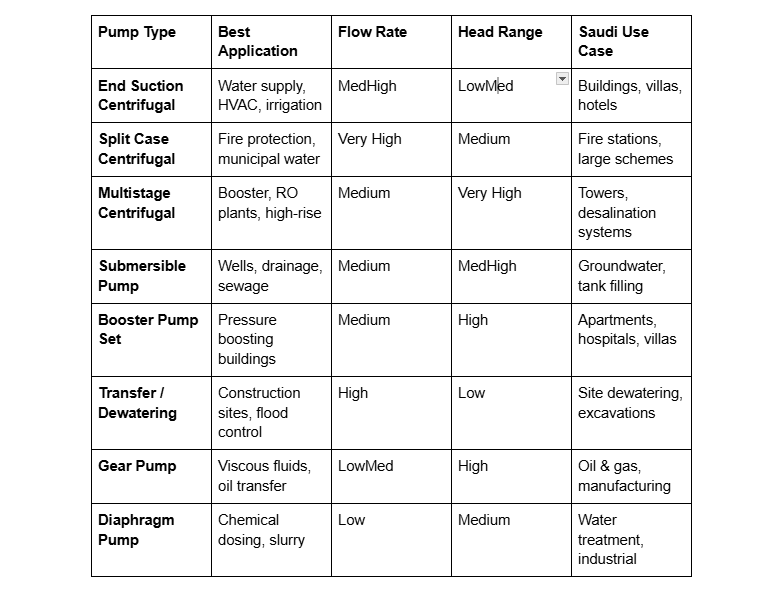
Comparing the different types of pumps helps engineers quickly identify the right solution. Use the table below as a quick reference when evaluating different types of pumps and their functions for your specific application:
End Suction Centrifugal Pumps:
- Best Application: General water supply, HVAC systems, and irrigation.
- Performance: Medium-to-high flow rates with low-to-medium head range.
- Saudi Use Case: Ideally suited for residential buildings, private villas, and hotels.
Split Case Centrifugal Pumps:
- Best Application: Large-scale fire protection systems and municipal water distribution.
- Performance: Very high flow rates with medium head range.
- Saudi Use Case: Extensively used in municipal fire stations and major government schemes.
Multistage Centrifugal Pumps:
- Best Application: Pressure boosting, Reverse Osmosis (RO) plants, and high-rise structures.
- Performance: Medium flow rates with a very high head range.
- Saudi Use Case: The standard for skyscrapers, towers, and desalination systems.
Submersible Pumps:
- Best Application: Deep well extraction, site drainage, and sewage management.
- Performance: Medium flow rates with a medium-to-high head range.
- Saudi Use Case: Essential for groundwater tapping and efficient tank filling across the Kingdom.
Booster Pump Sets:
- Best Application: Maintaining consistent water pressure in complex piping networks.
- Performance: Medium flow rates with a high head range.
- Saudi Use Case: Widely installed in large apartment complexes, hospitals, and luxury villas.
Transfer / Dewatering Pumps:
- Best Application: Construction site management and flood control.
- Performance: High flow rates with a low head range.
- Saudi Use Case: Crucial for site dewatering during excavations and urban flood mitigation.
Gear Pumps:
- Best Application: Transfer of viscous fluids, lubricants, and oil.
- Performance: Low-to-medium flow rates with a high head range.
- Saudi Use Case: Primarily used in the Saudi Oil & Gas sector and specialized manufacturing.
Diaphragm Pumps:
- Best Application: Precise chemical dosing and handling industrial slurry.
- Performance: Low flow rates with a medium head range.
- Saudi Use Case: Integral to water treatment facilities and industrial chemical processing.
Each of these different types of pumps must be matched carefully to system requirements.
Always match the pump curve to your system resistance curve. An undersized pump fails to deliver the required pressure; an oversized pump wastes energy and accelerates wear. Consider total dynamic head, design flow rate, fluid temperature, duty cycle, and available power supply.
Why Source Your Pumping Systems from El Buroj?
El Buroj is a trusted MEP and construction materials supplier serving contractors and procurement teams across Saudi Arabia. We offer:
- Wide pump inventory with fast delivery across the Kingdom
- Competitive pricing with project-volume discounts
- Technical support for pump selection, hydraulic sizing, and specification
- Complete MEP supply: piping, electrical cables, panels, HVAC, and safety systems, all from one supplier
El Buroj supplies the complete range of different types of pumps, piping, electrical cables, switchgear, and HVAC components to contractors and procurement teams across Saudi Arabia.
Fast delivery across KSA | Competitive pricing | Technical MEP support | Single-source procurement
Call: 920031298
WhatsApp: Click to Message El Buroj for a Project Quote
FAQs About Different Types of Pumps
What are the main types of pumps?
The main types of pumps are centrifugal (end suction, split case, multistage), submersible, booster sets, transfer pumps, gear pumps, and diaphragm pumps. Each is designed for specific head pressures, flow rates, and fluid types. Selecting the correct type from the different types of pumps available is the foundation of any reliable fluid system.
What is the most common pump type?
The end-suction centrifugal pump is the most widely used pump type globally and across Saudi Arabia. It is cost-effective, straightforward to maintain, and suitable for general water supply, HVAC, and light industrial applications, making it the default choice for most building services projects.
What is the difference between centrifugal and submersible pumps?
Centrifugal pumps are surface-mounted and draw fluid through suction pipework. Submersible pumps are sealed units that operate while fully submerged, eliminating priming and making them ideal for deep wells, underground tanks, sewage lift stations, and construction dewatering applications across Saudi Arabia.
How do I choose the right pump for a Saudi project?
Determine your required flow rate (m³/hr), total dynamic head (m), fluid type, duty cycle, and available power supply. Factor in Saudi conditions: high ambient temperatures require IP55-rated motors minimum. Contact El Buroj's technical team for project-specific selection support and hydraulic calculations at no cost.
What pump types are required for firefighting in Saudi Arabia?
SCD regulations and NFPA 20 require a UL-listed electric main fire pump (split case centrifugal), a diesel backup pump, and a jockey pump for pressure maintenance. All must have an automatic controller with start-on-pressure-drop logic. Equipment must be tested and certified before occupancy permits are issued.
What is the difference between the types of centrifugal pump configurations?
End suction pumps suit low-to-medium head applications. Split case pumps offer high flow and easy access for maintenance. Multistage pumps build very high head through multiple impeller stages. The right centrifugal pump type is determined by plotting your system curve requirements against each pump's published performance curve.