
Understanding the types of earthing systems is essential for every electrical engineer, MEP contractor, and procurement specialist working on projects in Saudi Arabia. The correct earthing design determines worker safety, equipment protection, and compliance with the Saudi Building Code (SBC) and IEC 60364. Whether specifying a TN-S earthing system for a hospital or a TN-C-S configuration for a residential tower, choosing the wrong types of earthing systems creates risk and costly rework. This guide covers all major types of electrical earthing systems, their comparison, and how to select the right solution with products available from El Buroj.
What is an Earthing System and Why is it Critical?
Definition: An earthing system (also called a grounding system) is the network of conductors and electrodes that connects exposed metal parts of electrical installations to the earth, providing a low-impedance fault current path that safely dissipates dangerous voltages and triggers protective devices.
In Saudi Arabia's extreme climate with sandy, high-resistivity soil and demanding load cycles, selecting the right types of earthing systems is not optional. It serves three core purposes:
- Personnel Safety: Prevents lethal touch voltages by ensuring fault currents trip circuit breakers within milliseconds.
- Equipment Protection: Shields motors, drives, and control panels from transient overvoltages and lightning surges.
- EMC Compliance: Provides a stable reference potential for sensitive electronic and data centre equipment.
Projects across the Kingdom, including those governed by the Saudi Electricity Company (SEC) distribution standards and the National Electrical Code (NEC) adaptations, require certified earthing designs. Integrating certified safety systems from the outset avoids costly retrofits and project delays.
What are the types of earthing systems?
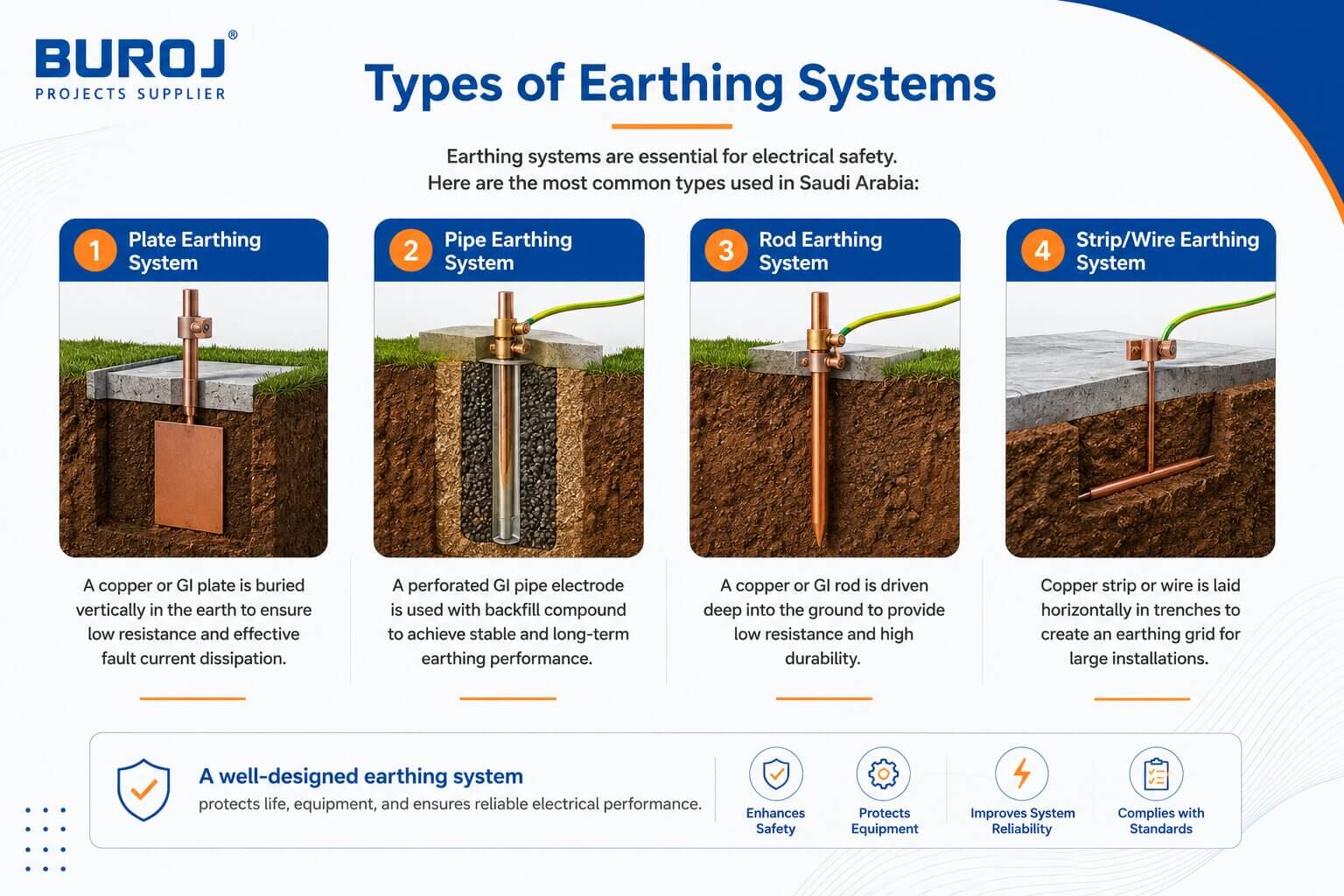
The International Electrotechnical Commission (IEC 60364-1) classifies types of earthing systems using a two-letter code system. The first letter defines the relationship of the power source to earth; the second defines the relationship of exposed conductive parts to earth. The three primary types of earthing systems used in Saudi Arabia are:
1. TN System (Terra Neutral)
In a TN earthing system, the source has one point directly connected to earth, and all exposed conductive parts of the installation are connected to that earth point via protective conductors. This is the most common system type in Saudi commercial and industrial applications. The TN family includes TN-S, TN-C, and TN-C-S variants.
2. TT System (Terra Terra)
In a TT system, the source has one point directly earthed, but the exposed conductive parts of the installation are connected to earth electrodes independent of the source earth. TT systems are often used where the distribution network earthing is unreliable, common in some remote Saudi project sites, agricultural installations, and temporary site supply.
3. IT System (Isolated Terra)
The IT system has no direct connection between live parts and earth (or a very high impedance connection). Exposed conductive parts are independently earthed. IT systems are favoured in fault-critical environments such as operating theatres and pharmaceutical plants, where a first fault must not cause an immediate supply interruption.
Regardless of system type, low-resistance earthing cables are vital for fault current performance. El Buroj supplies a comprehensive range of low voltage cables certified to IEC standards and suitable for all three earthing system types.
Need Help Choosing the Right Earthing System?
El Buroj provides complete earthing solutions in Saudi Arabia, including system design, material supply, site implementation, and compliance support for commercial, industrial, and infrastructure projects.
Request a consultation today via WhatsApp or call 920031298.
Deep Dive into TN Earthing Systems
The TN earthing system is subdivided into three configurations, each with distinct performance characteristics. Understanding their differences is critical when specifying types of earthing systems for Saudi projects.
TN-S Earthing System
The TN-S earthing system uses separate Neutral (N) and Protective Earth (PE) conductors throughout the entire installation. The PE and N conductors are only connected at the source (transformer or generator neutral point).
- Advantage: Eliminates neutral-to-earth voltage on exposed metalwork, providing the highest level of electromagnetic cleanliness.
- Use cases: Hospitals, data centres, commercial towers, and precision manufacturing in KSA.
- Standard: Mandated under IEC 60364-1 for installations where EMC and safety are paramount.
The tn s earthing system requires high-quality XLPE-rated PE cables to maintain insulation integrity over long cable runs. El Buroj's range of XLPE cables is specifically suited to TN-S installations in commercial and industrial projects.
TN-C Earthing System
In the TN-C configuration, the Neutral and Protective Earth functions are combined in a single conductor called the PEN (Protective Earth Neutral) conductor. This reduces cabling costs but introduces limitations: the PEN conductor must not be interrupted by any switching device, and it creates potential for EMC interference on sensitive equipment circuits. TN-C is increasingly restricted under modern Saudi electrical codes and is mainly found in older industrial installations.
TN-C-S Earthing System
The TN-C-S system (also known as PME Protective Multiple Earthing) uses a combined PEN conductor in the supply portion, which is then split into separate N and PE conductors at the point of entry to the building. This hybrid approach is the most widely used configuration in Saudi residential and mixed-use developments, balancing cost and safety performance.
Technical Comparison: TN-S vs TN-C vs TN-C-S vs TT
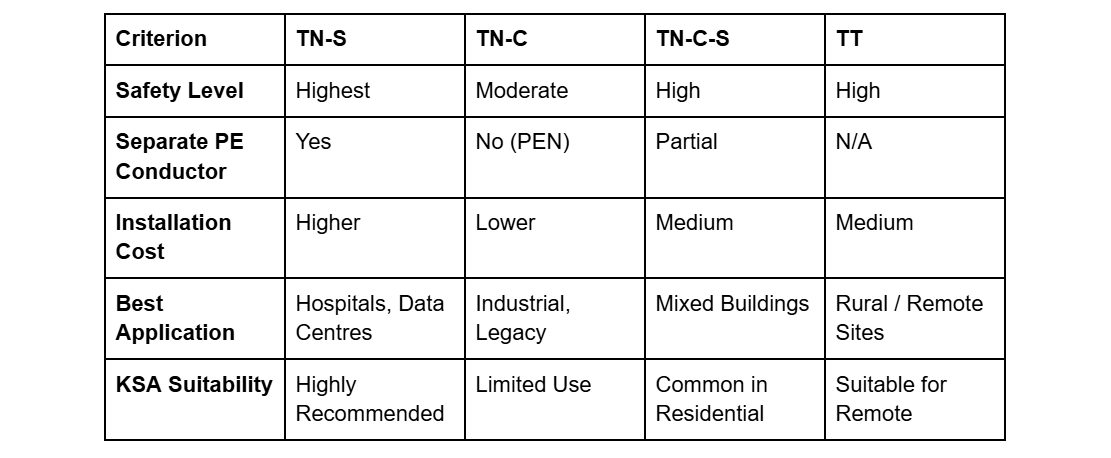
The table below provides a direct comparison of the main types of earthing systems to support design decisions on Saudi projects:
- TN-S System: Offers the highest level of electrical safety with a completely separate PE (Protective Earth) conductor from the neutral conductor. It is the preferred choice for hospitals, data centres, and sensitive commercial facilities. Although installation costs are higher, the TN-S system is highly recommended for projects in Saudi Arabia.
- TN-C System: Uses a combined PEN conductor for both neutral and protective earth functions, reducing installation costs but providing a moderate safety level compared to other systems. It is mainly used in older industrial installations and has limited use in modern Saudi projects.
- TN-C-S System: Combines the advantages of TN-S and TN-C by separating the PE and neutral conductors after the main supply point. It offers high safety with medium installation costs and is one of the most commonly used earthing systems in residential and mixed-use buildings across Saudi Arabia.
- TT System: Uses an independent earth electrode separate from the utility grounding system. It is commonly applied in rural areas and remote project sites where supply earthing may be unreliable. The TT system provides high safety with medium installation costs and is suitable for remote Saudi installations.
For installations requiring enhanced fault protection, pairing any TN system with certified electrical circuit breakers from El Buroj ensures compliant overcurrent protection coordination.
Designing an Earthing System for Your Project?
From TN-S and TN-C-S system design to grounding calculations, electrode selection, and on-site installation, El Buroj delivers fully integrated earthing and grounding solutions tailored to Saudi project requirements and SBC standards.
Get BOQ support and fast project pricing today.
Call: 920031298 | WhatsApp Us Now
Essential Components of an Earthing System
Regardless of which of the types of earthing systems is selected, all grounding designs share the same fundamental components. Specifying the correct grade of materials is critical for long-term performance in Saudi soil and climate conditions.
1. Earth Electrode / Ground Rod
- Function: Dissipates fault current safely into the soil
- Typical Standard: IEC 62561 / BS 7430
2. Earthing Conductor
- Function: Connects the earth electrode to the main earth bar
- Typical Standard: IEC 60364
3. Earth Busbar (MEB)
- Function: Acts as the central bonding point for all earthing connections
- Typical Standard: Saudi Building Code (SBC)
4. Protective Earth (PE) Cables
- Function: Routes fault current back to the source to enable protection devices to operate
- Typical Standard: IEC 60228 / XLPE rated
5. Earth Clamps & Connectors
- Function: Provide secure mechanical and electrical bonding between components
- Typical Standard: IEC 62561-2
For the PE conductors themselves, El Buroj stocks a dedicated range of Yellow/Green Earthing Cables, the colour-coded PE conductors mandated by IEC 60446, alongside bare copper cables for equipotential bonding rings and strip earthing grids.
Distribution panels housing earth busbars must meet SEC and SBC specifications. El Buroj offers a full range of electrical panels for both residential and industrial earthing distribution applications.
Selecting the Right Earthing System for Your Saudi Project
Choosing between the types of earthing systems for a KSA project requires evaluating four key factors:
1. Soil Resistivity and Site Conditions
Saudi Arabia's arid, sandy soils typically exhibit high resistivity (5005,000 Ω·m), requiring chemical earthing compounds or deep-driven electrodes to achieve the required earth resistance (typically ≤1 Ω for substations, ≤10 Ω for LV systems). TT systems are preferred where the site soil is unpredictable or remote from the supply earthing network.
2. Load Type and Sensitivity
Data centres, hospitals, and laboratory environments demand the TN-S earthing system for its clean PE/N separation. Heavy industrial loads with significant harmonic content may also benefit from TN-S to prevent neutral current interference on the PE conductor.
3. Saudi Regulatory Compliance
All earthing designs in Saudi Arabia must comply with:
- Saudi Building Code (SBC 401) Electrical Requirements
- IEC 60364-1 through IEC 60364-7 Low Voltage Electrical Installations
- SEC Distribution System Requirements
- NFPA 70 (NEC) adaptations for specific project types
Each factor directly impacts which of the types of earthing systems is most suitable.
Incorporating compliant low-current and control systems alongside your earthing design ensures full electrical coordination across all voltage levels.
4. Project Scale and Future Expansion
Large campus projects, NEOM, Qiddiya, and healthcare cities benefit from TN-C-S or TN-S designs that accommodate phased expansion. IT systems should be specified wherever supply continuity during a first fault is a contractual requirement.
El Buroj Earthing Products: Complete Catalogue for KSA Projects
El Buroj stocks a dedicated earthing category covering the full bill of materials for any of the types of earthing systems described in this guide. Products are sourced from Furse (ABB), a specialist brand for earthing and lightning protection and other internationally certified manufacturers, all compliant with IEC, BS, and SEC specifications.
Browse El Buroj's complete earthing product range or explore individual categories below.
1. Earthing Electrodes
Earthing electrodes create the physical contact between the electrical installation and the earth. El Buroj's Earthing Electrodes category sourced from ABB includes:
- Earth Rods: Copper-bonded steel rods (typically 14.2 mm diameter, 1,200 2,400 mm lengths). Preferred for single-point electrodes in TN and TT systems. Deep-driven rods are essential in Saudi Arabia's high-resistivity sandy soils.
- Earthing Plates: Solid copper or galvanised steel plates buried horizontally. Effective where vertical rod driving is limited by rock or compact subsoil.
- Earthing Mats / Grid Electrodes: Mesh or grid configurations used for substations, large industrial facilities, and switchgear yards requiring a very low resistance (≤1 Ω). Suitable for all earthing system types at the source or substation level.
2. Earthing Accessories
The Earthing Accessories category covers all the connection hardware needed to complete a compliant earthing installation:
- Earth Rod Couplings & Driving Heads: Allow multiple rods to be driven in series to achieve depth without conductor breaks.
- Earth Clamps & Connectors: Bronze and stainless-steel clamps rated to IEC 62561-2 for secure mechanical and electrical bonds between electrodes, conductors, and structural metalwork.
- Earth Busbars (MEB / SMEB): Main Earthing Busbars and Sub-Main Earthing Busbars form the central bonding points for all PE conductors in a TN-S or TN-C-S installation.
- Exothermic Welding (Cadweld): Permanent molecular-bond connections for underground and high-fault-current joints required in substation earthing grids and industrial facilities.
3. Earthing Cables and Conductors
Earthing cable selection is as important as the electrode type. El Buroj supplies three complementary categories:
- Yellow/Green Earthing Cables: IEC 60446-compliant PE conductors, 1.5 mm² to 300 mm², for all TN-S and TN-C-S installations.
- Bare Copper Cables: for equipotential bonding rings, strip earthing grids, and electrode connection tails.
- XLPE Power Cables: armoured PE conductors for buried duct or direct-buried runs in KSA's harsh soil conditions.
4. Electrical Panels and Circuit Protection
Earthing systems terminate in the distribution infrastructure. El Buroj's range of electrical panels and circuit breakers completes the fault protection loop, ensuring that when a fault current flows through the earthing system, overcurrent protective devices operate within the disconnection times required by IEC 60364-4-41.
Complete Earthing & Grounding Solutions Across Saudi Arabia
El Buroj supports contractors and project developers with end-to-end earthing services, including grounding system design, supply of certified materials, installation, testing, and technical supervision for residential, commercial, and industrial projects.
Contact El Buroj now for technical consultation, project execution, and competitive pricing.
Call: 920031298 | WhatsApp Us Now
FAQs: Types of Earthing Systems
What are the main types of earthing systems?
The main types of earthing systems under IEC 60364 are TN (with TN-S, TN-C, and TN-C-S sub-types), TT, and IT. Each differs in how the source neutral, and the installation's exposed conductive parts are connected to earth. In Saudi Arabia, TN-C-S and TN-S are the most widely specified types of earthing systems for commercial and industrial projects.
What is the TN-S earthing system?
The TN-S earthing system uses completely separate Protective Earth (PE) and Neutral (N) conductors throughout the installation, connected only at the source. This eliminates neutral-to-PE voltage on exposed metalwork and is the safest grounding configuration. The TN-S earthing system is required for hospitals, data centres, and precision facilities under IEC 60364-4-41.
Which earthing system is best for Saudi Arabia?
It depends on the project type. The tn s earthing system is best for sensitive commercial and institutional buildings. TN-C-S suits standard residential developments. TT is preferred for remote sites with unreliable supply earthing. IT systems are used where supply continuity during a first fault is contractually required.
What standards govern earthing design in Saudi Arabia?
KSA earthing designs must comply with the Saudi Building Code (SBC 401), IEC 60364 series, and Saudi Electricity Company (SEC) distribution standards. BS 7430 and NFPA 70 are also referenced depending on the project consultant's specifications.